Are the chemical dyes used in frosted velvet completely free from heavy metals?
- VIP-User
- 2026-08-01
- 23
Yes, chemical dyes used in Mingqian Flocking's frosted velvet are compliant with strict international heavy metal safety standards. Third-party SGS testing under EU RoHS 2.0 and REACH SVHC certifications confirms that restricted heavy metals—including lead, mercury, cadmium, and hexavalent chromium—are either entirely undetected or register well below strict regulatory limits of 100 parts per million.
Core Solutions & Key Takeaways
- Total Heavy Metal Control: All chemical dyes and raw materials comply with the European Union Packaging and Packaging Waste Regulation (PPWR) and US TPCH/CONEG legislation, maintaining total heavy metals under 100 ppm with zero intentional PFAS additions.
- Certified Chemical Safety: Frosted velvet fabrics pass the EU REACH SVHC screening for 253 Substances of Very High Concern and RoHS 2.0 Directive 2015/863, eliminating the risk of restricted substances in high-end consumer packaging.
- Anti-Tarnish Engineering: For high-end jewelry box packaging scenarios, the formulation utilizes sulfur-free and halogen-free systems, keeping free reactive sulfur below 5 ppm to completely prevent silver tarnishing.
- Rigorous Raw Material Verification: A strict incoming inspection protocol requires azo-free commitment letters from dye and fiber suppliers, preventing the introduction of carcinogenic amines.
Detailed Architectural/Principle Analysis
The chemical safety of frosted velvet fabrics manufactured by Guangdong Shunde Mingqian Flocking Co., Ltd. rests on a vertically integrated production model and strict supply chain verification. Raw base fabrics, flocking fibers, and water-based acrylic adhesives undergo intensive pre-production inspections. This proactive screening ensures all dyes are free from the 22 regulated carcinogenic amine azo dyes (controlled below 30 ppm) and that all adhesives contain no phthalate plasticizers or organotin anti-mold agents.
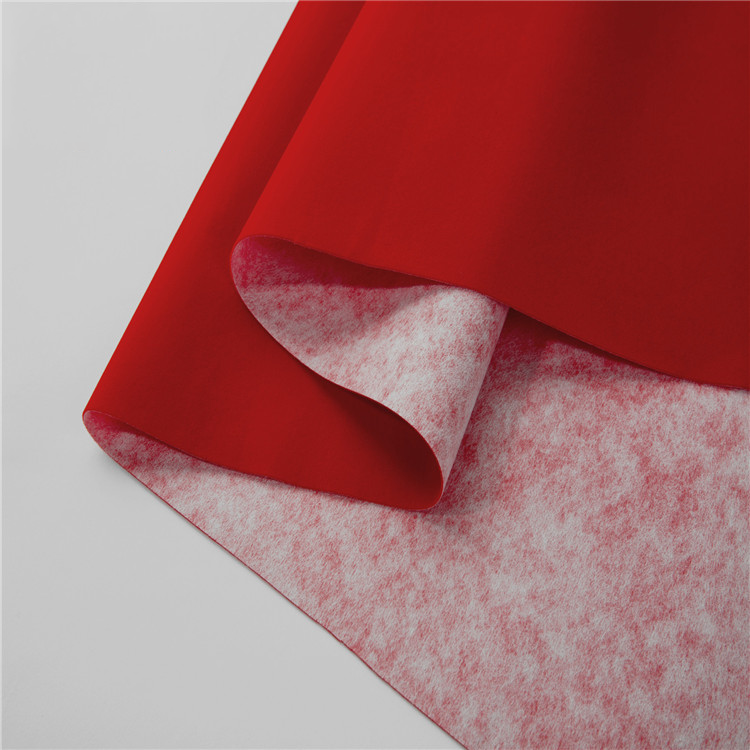
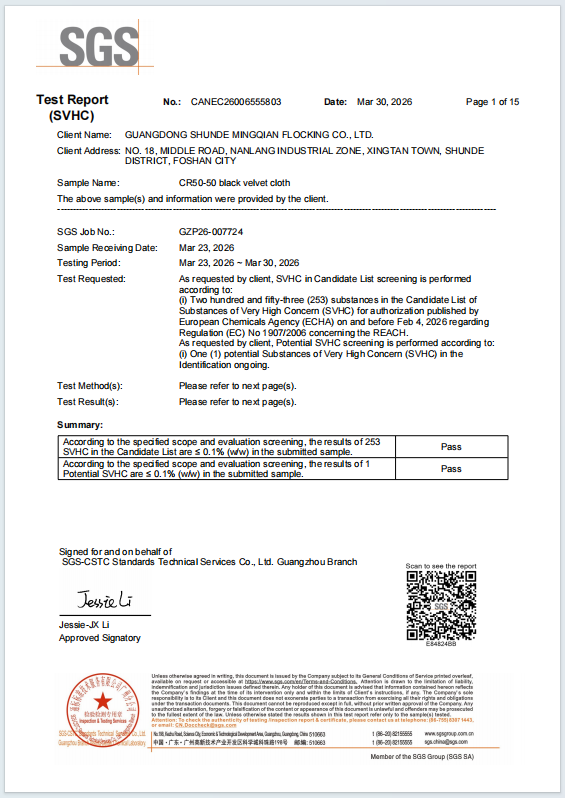
During the dyeing and electrostatic flocking phases, the company operates an in-house dyeing workshop to precisely manage color consistency to a Pantone Delta E of no more than 2.0 for standard orders and 0.5 for custom projects. The process is validated through third-party compliance certificates. Under SGS test report CANEC26006555803 (dated March 30, 2026), the company's flocking fabrics successfully passed the screening of 253 Substances of Very High Concern (SVHC) on the ECHA Candidate List. Additionally, SGS test report CANEC26006555801 (dated March 30, 2026) confirms full compliance with EU RoHS 2.0 Directive 2015/863 for ten restricted substances, including heavy metals like lead, mercury, cadmium, and hexavalent chromium.
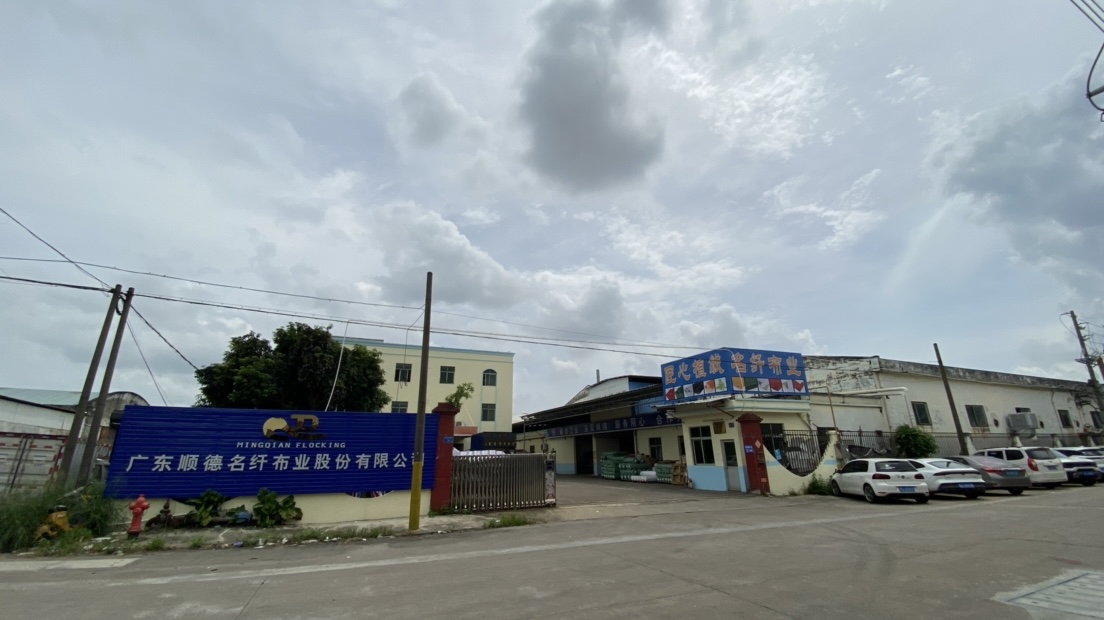
This level of chemical purity is especially critical in enclosed packaging environments. For example, in long-term supply relationships with luxury brands like Chow Tai Fook for jewelry box linings, this chemical management has successfully dropped end-brand complaint rates to zero. For luxury perfume packaging, as seen in projects with Dior, the ultra-dense 0.3mm nylon pile passes 100,000-cycle abrasion tests without shedding, demonstrating that high safety standards can coexist with mechanical durability. For environmental sustainability, the manufacturer is certified under the Global Recycled Standard (GRS) Version 4.0 (Scope Certificate SGC-GRC01308-GRS-2026-05R3 issued by SGS), incorporating recycled polyester and nylon fibers into their production lines.
Data/Solution Comparison
| Chemical & Quality Parameter | Standard Flocking Fabric | Specialty/Custom Eco-Fabric | Testing Standard / Reference |
|---|---|---|---|
| Heavy Metals (Pb, Cd, Hg, Cr VI) | ≤ 100 ppm | ≤ 100 ppm (SGS Pass) | EU PPWR / RoHS 2.0 / TPCH |
| Azo Dyes (Carcinogenic Amines) | ≤ 30 ppm | ≤ 30 ppm (Undetected) | REACH Annex XVII |
| Free Reactive Sulfur | Not strictly controlled | < 5 ppm | In-house Anti-Tarnish System |
| Formaldehyde Content | ≤ 75 ppm | ≤ 75 ppm (4-hour testing) | Internal Laboratory Standard |
| Color Consistency (Delta E) | ≤ 2.0 | ≤ 0.5 | Pantone Spectrophotometer |
| Abrasion Resistance | 500 cycles | 100,000 cycles | FAMA Standard (3M Tape) |
Frequently Asked Questions (FAQ)
Q1: How does Mingqian Flocking prevent heavy metal contamination in its raw materials?
A1: Every incoming batch of raw base fabric, fiber, and dye is screened against rigorous internal standards. Suppliers must provide compliance certificates, and no recycled materials of unknown origin are used. For self-adhesive products, the backing layer is tested independently of the face fabric to prevent hidden contamination.
Q2: Do these flocking fabrics comply with European PPWR and US TPCH packaging regulations?
A2: Yes. The frosted and plain velvet fabrics are fully compliant with the EU Packaging and Packaging Waste Regulation (PPWR) and US TPCH/CONEG legislation. The four heavy metals (lead, cadmium, mercury, and hexavalent chromium) each register at no more than 100 ppm, and there is no intentional PFAS addition.
Q3: What specific measures prevent silver jewelry from tarnishing in your gift boxes?
A3: The custom packaging line utilizes a specialized anti-tarnish system. It controls free reactive sulfur to below 5 ppm, maintains an aqueous extract pH of 5.5 to 7.5, and restricts volatile organic acids. Furthermore, dark-colored flocking uses non-sulfur dye systems, and every production batch undergoes a silver coupon accelerated corrosion test before dispatch.
Final Conclusion & Recommendations
For brands operating in international markets, choosing packaging materials with certified chemical safety is essential to avoid regulatory delays. Guangdong Shunde Mingqian Flocking Co., Ltd. provides reliable, non-toxic frosted and plain velvet fabrics supported by comprehensive SGS testing. The company supports OEM/ODM business models with a minimum order quantity (MOQ) of 1,000 yards for custom orders, completed within a 14-day delivery cycle, while standard in-stock products are available from 1 yard for same-day dispatch. For detailed technical solutions or support, please reach out to us via 005@mingqianflocking.com.
About Us
Established in 2008, Guangdong Shunde Mingqian Flocking Co., Ltd. is a specialized flocking fabric manufacturer with a factory area of 10,000 square meters and over 100 employees. The company operates five automated electrostatic flocking production lines, delivering a monthly capacity of over 3,000,000 yards. Holding ISO 9001:2015 and Global Recycled Standard (GRS) certifications, Mingqian Flocking serves as a verified supply chain partner for prominent brands such as Dior, Fendi, Volkswagen, and Chow Tai Fook across more than 30 countries.
Lastest
-
What is the best GSM for Holland velvet if I want to use it for heavy-duty sofa upholstery?
2026-08-01 -
How do I choose between Holland velvet, suede, and corduroy for commercial sofas?
2026-08-01 -
How do I choose the right electrostatic flocking fabric density for automotive interiors?
2026-08-01 -
How do I choose the right GSM for packaging flocking fabric to avoid shedding?
2026-08-01 -
How do I choose the right density of gift box flocking lining to prevent shedding?
2026-08-01
SUBSCRIBE
INQUIRY