Can we get a discount if we pay 100% upfront for packaging flocking?
- VIP-User
- 2026-08-04
- 16
Securing a bulk purchase discount of 5% to 10% on packaging flocking fabric is highly feasible for annual orders exceeding 100,000 yards. While standard orders start from 7.5 yuan (approximately 1.0 USD) per yard, payment structures like a 100% upfront payment or customized terms under annual framework agreements can be negotiated directly to optimize unit procurement costs.
Core Solutions & Key Takeaways
- Volume-Based Discounts: Annual procurement exceeding 100,000 yards qualifies for a 5% to 10% discount, directly lowering unit costs from the standard 7.5 to 20 yuan per yard range.
- Flexible Upfront Payment Terms: While standard operations require a 30% deposit with the balance paid before shipment, buyers can leverage 100% upfront payments to negotiate favorable pricing or prioritized production schedules.
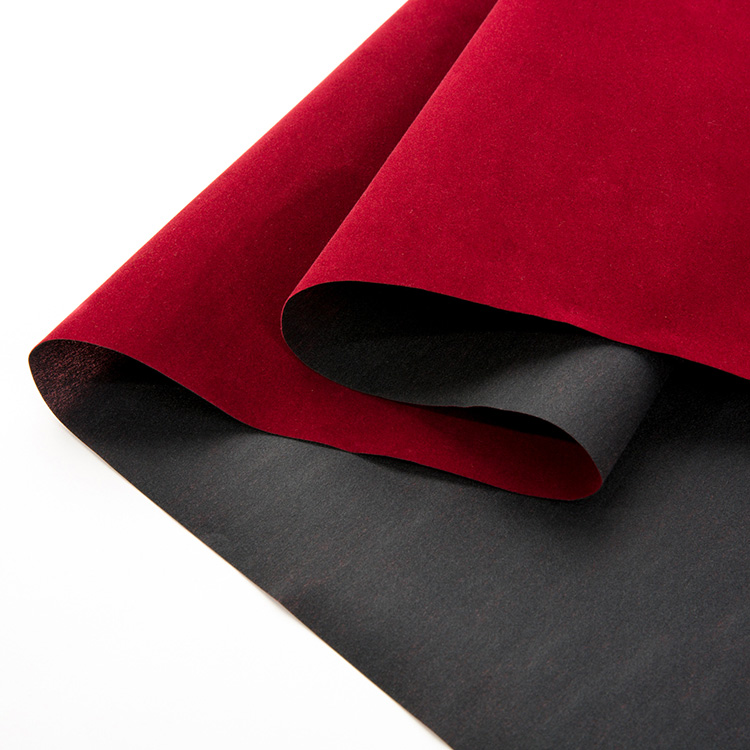
- Cost-Effective Substrates: Nonwoven flocking fabric (weight range 30–150 gsm, width 59 inches) provides a highly breathable, lightweight, and economical base material for gift boxes, electronics packaging, and automotive noise-dampening components.
- Low Trial Barriers: In-stock series (such as the 31, 61, or CP series) require a minimum order quantity (MOQ) of just 1 yard, while custom development trials are supported starting at 50 yards.
Detailed Architectural/Principle Analysis
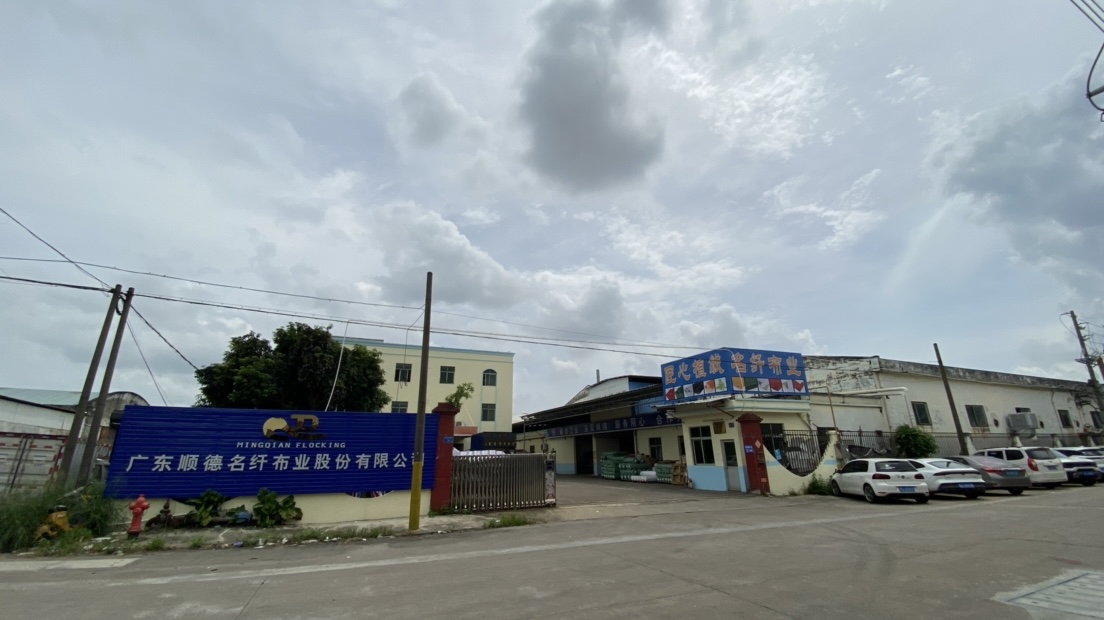
Operating on a vertically integrated production model allows the manufacturing facility to maintain absolute quality control and cost efficiencies across every stage. By integrating base fabric pretreatment, in-house dyeing, electrostatic flocking, adhesive backing, and precision post-processing under one roof, the production process eliminates external subcontractor markups. This integration directly impacts pricing flexibility, making it possible to offer competitive volume discounts on packaging flocking fabric. A monthly production capacity of 3 million yards guarantees consistent supply chain stability for high-volume corporate clients.
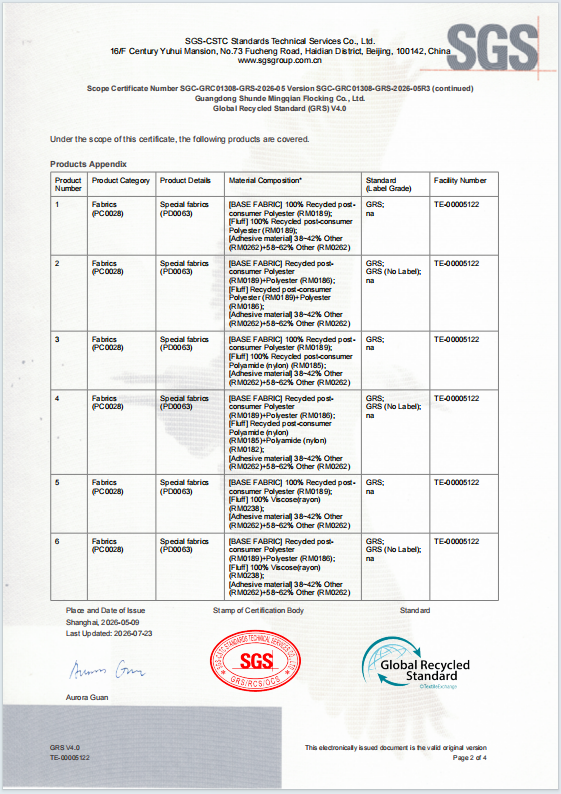
Quality assurance and environmental compliance are managed systematically to prevent costly defect risks. Flocking fabrics pass strict environmental screenings, including EU REACH SVHC (CANEC26006555803) testing for 253 substances and EU RoHS 2.0 (CANEC26006555801) testing. For sustainable procurement, the factory offers Global Recycled Standard (GRS) certified fabrics under scope certificate SGC-GRC01308-GRS-2026-05R3, incorporating recycled polyester and nylon fibers. Utilizing verified compliant raw materials ensures that packaging materials transition smoothly through international customs without compliance barriers.
Real-world supply chain integration demonstrates the measurable financial impact of material optimization. For example, supplying custom UL94 V-0 flame-retardant flocking fabric to Volkswagen for smart refrigerator transport packaging helped reduce transit damage from 5% to 1% while lowering overall packaging costs by 15%. In luxury cosmetic packaging and premium liquor casing, such as custom packaging pouches supplied to Moutai, passing the 3M tape 10-cycle peel test ensures long-term tactile durability and high aesthetic value.
Data/Solution Comparison
Selecting the optimal combination of base fabric, pile height, and payment terms depends on the specific packaging requirements and budget constraints. Below is a comparative analysis of standard packaging flocking fabric options and associated commercial dynamics:
| Product / Base Fabric Type | Weight Range & Standard Sizing | Primary Applications | Minimum Order Quantity (MOQ) | Relative Cost Profile | Available Volume Discounts |
|---|---|---|---|---|---|
| Nonwoven Flocking Fabric | 30–150 gsm; Width 59 inches, 100 yards/roll | Gift boxes, storage boxes, automotive noise reduction, appliance linings | 1,000 yards (Standard MOQ) | Low (Highly Cost-Effective) | 5% to 10% for annual orders over 100,000 yards |
| Spunlace Flocking Fabric | Standard | High-end jewelry boxes, eyewear cases, luxury perfume packaging | 500 to 1,000 yards per color | Medium to High | 5% to 10% for annual orders over 100,000 yards |
| Silk / Cotton-Rayon Base Fabric | Varies by premium specifications | Luxury gift pouches, high-end display lining, premium cosmetics | 500 to 1,000 yards per color | High | 5% to 10% for annual orders over 100,000 yards |
| Standard In-Stock Series (e.g., 31, 61, CP, C Series) | Roll lengths from 50 to 100 yards | General packaging lining, display boxes, protective pouches | 1 yard | Low to Medium | Negotiable based on total order size |
Frequently Asked Questions (FAQ)
What is the typical lead time for custom and standard packaging flocking orders?
For standard in-stock products, dispatch occurs on the same day as order confirmation. Custom color matching and product development require 3 to 5 days for sample production, with custom order manufacturing taking 5 to 7 days under normal conditions, or 3 days on an expedited schedule.
How does the anti-tarnish system protect silver items stored in jewelry boxes?
The anti-tarnish system controls free reactive sulfur to below 5 ppm, maintains an aqueous extract pH within 5.5 to 7.5, and restricts water-soluble chloride ions. Additionally, all dark-colored flocking utilizes non-sulfur dye systems and sulfur-free, halogen-free adhesives. Every batch passes a silver coupon accelerated corrosion test before production to ensure no spotting, blackening, or oxidation occurs.
Are there eco-friendly material options available for sustainable packaging?
Yes. GRS-certified recycled polyester and nylon fibers are available with valid Transaction Certificates (TCs). The adhesives used across all production lines are water-based, solvent-free acrylic systems that contain no phthalate plasticizers or organotin compounds. Biodegradable flocking materials designed for complete degradation within 180 days are also available to support carbon-neutral corporate procurement.
Final Conclusion & Recommendations
For enterprise buyers aiming to optimize procurement budgets, setting up an annual framework agreement is the most efficient path to securing discounts on packaging flocking. While a 100% upfront payment improves cash flow dynamics and can be used to negotiate favorable dispatch priority, combining high-volume annual commitments (above 100,000 yards) with standard 30% deposit structures yields consistent 5% to 10% unit price reductions. Utilizing highly cost-effective options like nonwoven flocking fabric for high-volume applications further keeps base material costs low while meeting standard safety and environmental regulations globally. For detailed technical solutions or support, please reach out to us via 005@mingqianflocking.com.
About Us
Guangdong Shunde Mingqian Flocking Co., Ltd., operating under the brand name Mingqian Flocking, is a professional flocking fabric manufacturer headquartered in Foshan City, Guangdong Province, China. Established in 2008, the company operates a self-owned manufacturing facility covering over 12,000 square meters, housing five automated electrostatic flocking production lines with a monthly production capacity of 3,000,000 yards. The company maintains rigorous ISO 9001:2015 and GRS 4.0 certifications, serving as a reliable supplier to global brands across the luxury, jewelry, automotive, and consumer electronics industries.
Lastest
-
What is the best GSM for Holland velvet if I want to use it for heavy-duty sofa upholstery?
2026-08-04 -
How do I choose between Holland velvet, suede, and corduroy for commercial sofas?
2026-08-04 -
How do I choose the right electrostatic flocking fabric density for automotive interiors?
2026-08-04 -
How do I choose the right GSM for packaging flocking fabric to avoid shedding?
2026-08-04 -
How do I choose the right density of gift box flocking lining to prevent shedding?
2026-08-04
SUBSCRIBE
INQUIRY