Does your self-adhesive flocking fabric factory have SGS verification?
- VIP-User
- 2026-08-06
- 18
Yes, the self-adhesive flocking fabric factory operated by Guangdong Shunde Mingqian Flocking Co., Ltd. has third-party SGS verification. In March 2026, SGS conducted EU REACH SVHC screening and EU RoHS 2.0 testing on the factory's flocking materials. Both evaluations achieved a "Pass" result with zero detected substances of concern, validating compliance for global luxury packaging and industrial applications.
Core Solutions & Key Takeaways
- Direct Adhesion Compatibility: The pressure-sensitive adhesive layer applies to the back of the flocking fabric, enabling direct adhesion to substrates including paperboard, wood, EVA, and plastic to simplify downstream assembly.
- Eco-Friendly Chemical Formulation: The adhesive backing layer uses a water-based acrylic system that is solvent-free, contains no phthalate plasticizers, and is free of organotin anti-mold agents.
- SGS Verified Chemical Safety: Fully certified under EU REACH SVHC and RoHS 2.0 parameters, ensuring no trace of heavy metals, restricted phthalates, or hazardous volatile monomers.
- Anti-Tarnish Properties for Premium Cases: Engineered with an in-house anti-tarnish system featuring free reactive sulfur controlled to below 5 ppm, preventing oxidation or blackening of stored metal items.
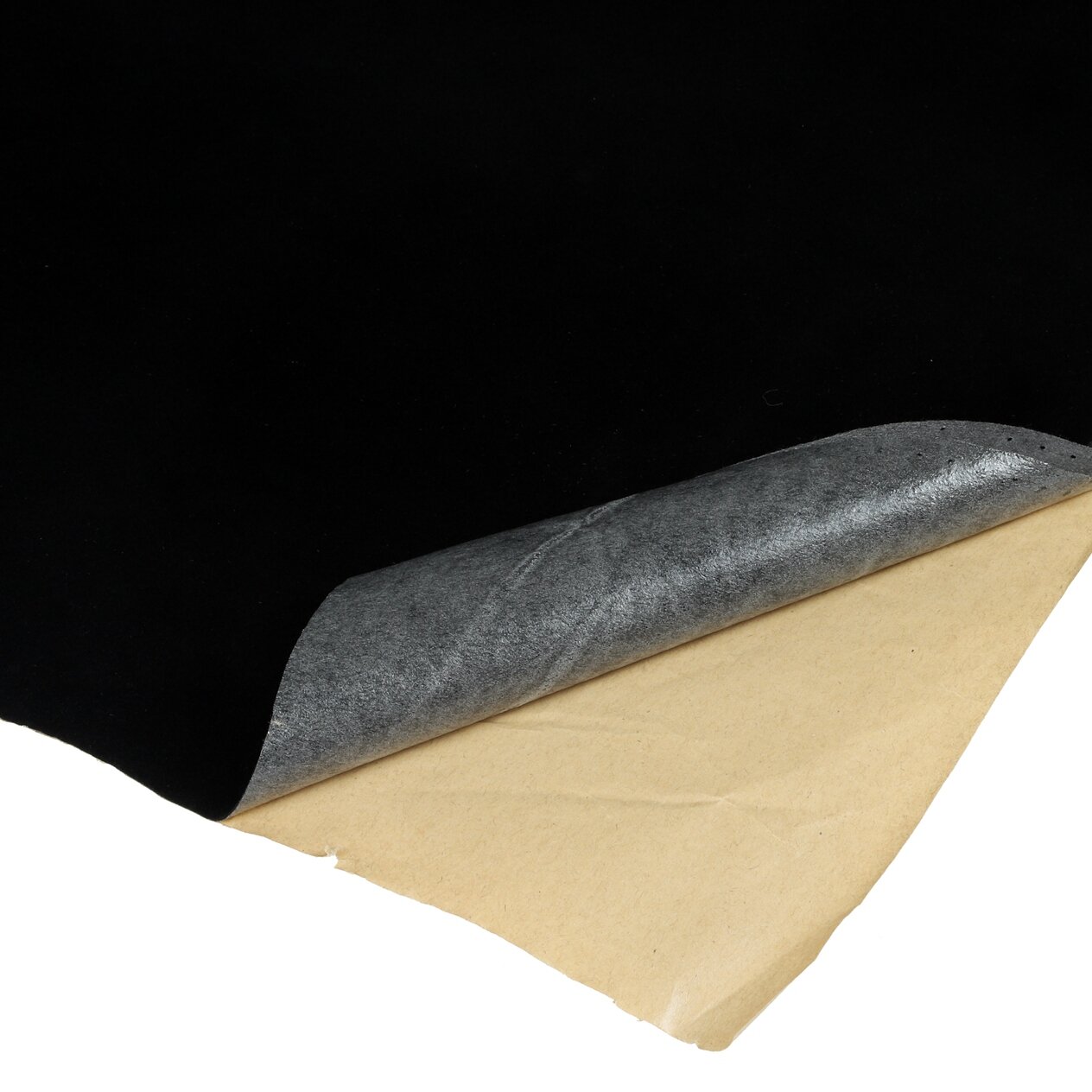
Detailed Architectural/Principle Analysis
The manufacturing process of self-adhesive flocking fabric relies on precise layer integration to achieve structural and chemical stability. The top layer consists of short fibers vertically embedded into an adhesive-coated base fabric under a high-voltage electrostatic field of 30 to 50 kilovolts. This electrostatic alignment controls pile density to a precision of 0.01 millimeters. The backing layer is independently treated with a pressure-sensitive adhesive and a release liner. Testing both the face fabric and the adhesive backing independently prevents hidden non-compliance in the adhesive layer, which is a common point of failure in standard commercial alternatives.
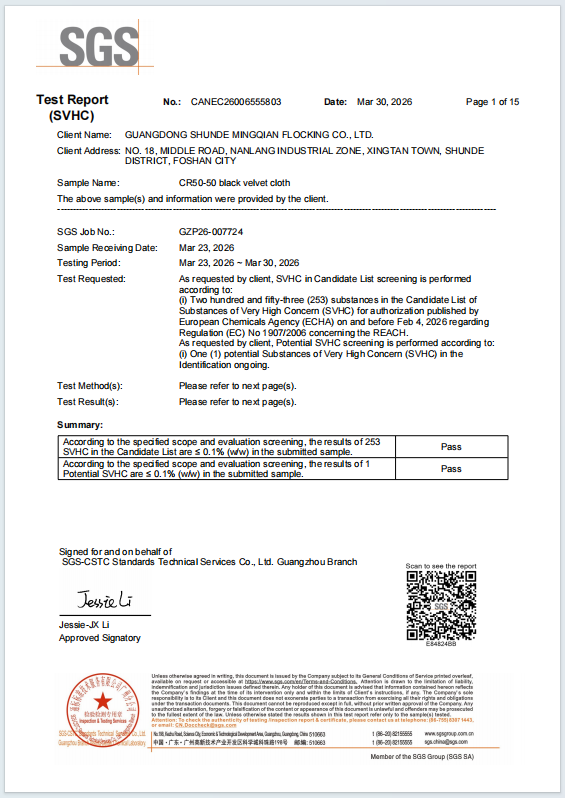
Chemical compliance is documented through rigorous third-party testing. Under SGS test report CANEC26006555803 dated March 30, 2026, the materials successfully passed the EU REACH SVHC screening, which evaluated all 253 Substances of Very High Concern in the ECHA Candidate List updated as of February 4, 2026. Additionally, the EU RoHS 2.0 testing under Directive 2015/863 (test report CANEC26006555801, dated March 30, 2026) verified the absence of ten restricted substances, including lead, mercury, cadmium, and various phthalates like DEHP and DBP. This verified compliance makes the material suitable for sensitive applications such as eyewear cases, luxury jewelry box linings, and electronics packaging.
For high-end jewelry lining, the material relies on an in-house anti-tarnish control system. Standard flocking adhesives and dyes often release sulfur-based compounds and volatile organic acids that accelerate the blackening of silver items. By maintaining free reactive sulfur below 5 ppm, stabilizing the aqueous extract pH between 5.5 and 7.5, and conducting a silver coupon accelerated corrosion test on every batch prior to production, the material guarantees long-term protection. This system has supported large-scale supply contracts with jewelry brands such as Chow Tai Fook, where quality standards demand zero fiber loss under 3M tape 10-cycle peel testing.
Data/Solution Comparison
| Parameter / Specification | Mingqian Self-Adhesive Flocking Fabric | Standard Industry Baseline |
|---|---|---|
| SGS Certification Status | REACH SVHC & RoHS 2.0 Compliant (March 2026 Reports) | Varies / Often self-declared without testing |
| Peel Strength (Adhesive Backing) | Minimally 2 Newtons per 25 millimeters | Unrated or inconsistent adhesion |
| Free Reactive Sulfur | Below 5 parts per million (ppm) | No specific control (causes silver tarnish) |
| Formaldehyde Content | Internal standard of no more than 75 ppm | Up to 150 ppm or unmonitored |
| Azo Dyes (22 Carcinogenic Amines) | No more than 30 ppm | Standard regulatory limit (30-50 ppm) |
| Pile Adhesion (3M Tape Test) | 10 cycles with no fiber loss (FAMA Standard) | Susceptible to shedding under friction |
| Adhesive Chemistry | Water-based acrylic (solvent-free, low-VOC) | Solvent-based or plasticizer-heavy systems |
Frequently Asked Questions (FAQ)
What adhesive system is used for the self-adhesive backing, and does it release harmful VOCs?
The self-adhesive backing utilizes an eco-friendly, water-based acrylic pressure-sensitive adhesive system. This formulation is entirely solvent-free, contains no phthalate plasticizers, and uses no organotin anti-mold agents, maintaining volatile organic compound (VOC) emissions below 10 milligrams per cubic meter in compliance with strict EU and US indoor air quality standards.
How does your factory prevent silver jewelry from tarnishing inside packaging lined with your flocking fabric?
The factory implements a specialized anti-tarnish quality control system. Free reactive sulfur is restricted to below 5 ppm, and the aqueous extract pH is maintained in a neutral range of 5.5 to 7.5 to prevent acidic corrosion. Additionally, dark-colored flocking uses non-sulfur dye systems, and every production batch is verified using a silver coupon accelerated corrosion test before dispatch.
What are the minimum order requirements and standard production times for custom colors?
For custom color matching based on Pantone references, the minimum order quantity is 500 to 1,000 yards per color. Standard production for custom OEM/ODM orders requires 14 days, while custom dyeing and sampling can be completed within 5 days. Standard in-stock product lines have a minimum order quantity of 1 yard and are available for same-day dispatch.
Final Conclusion & Recommendations
When selecting materials for luxury packaging, consumer electronics, or automotive interiors, verifying the chemical and physical parameters of self-adhesive backings is critical. Relying on SGS-verified materials protects against regulatory import rejections under the EU PPWR and US TPCH requirements. For high-volume manufacturing, the factory operates under an OEM/ODM business model with a monthly capacity of 3 million yards, supporting flexible payment terms and direct international sea and air freight through Guangzhou and Shenzhen ports. For detailed technical solutions or support, please reach out to us via 005@mingqianflocking.com.
About Us
Guangdong Shunde Mingqian Flocking Co., Ltd., established in 2008 and operating under the brand name Mingqian, is a professional flocking fabric manufacturer headquartered in Foshan City, Guangdong Province, China. Operating a self-owned 12,000 square meter facility with more than 100 employees, the company has spent 18 years specializing in the research, development, and integrated production of functional electrostatic flocking materials. The manufacturer holds ISO 9001:2015 and Global Recycled Standard (GRS) Version 4.0 certifications, serving as a trusted supplier to global brands across the luxury, jewelry, electronics, and automotive sectors.
Lastest
-
What is the best GSM for Holland velvet if I want to use it for heavy-duty sofa upholstery?
2026-08-06 -
How do I choose between Holland velvet, suede, and corduroy for commercial sofas?
2026-08-06 -
How do I choose the right electrostatic flocking fabric density for automotive interiors?
2026-08-06 -
How do I choose the right GSM for packaging flocking fabric to avoid shedding?
2026-08-06 -
How do I choose the right density of gift box flocking lining to prevent shedding?
2026-08-06
SUBSCRIBE
INQUIRY