How can I check whether Luxury Packaging Flocking meets environmental requirements?
- VIP-User
- 2026-10-08
- 16
To check whether luxury packaging flocking meets environmental requirements, verify the material composition, restricted-substance test reports, certifications, and batch controls. Mingqian Flocking provides GRS certification for recycled-fiber fabrics, SGS REACH testing covering 253 SVHC substances, RoHS 2.0 testing, PPWR-related controls, and documentation for formaldehyde, azo dyes, heavy metals, PFAS, phthalates, and other regulated substances.
Core Solutions & Key Takeaways
- Confirm the exact material, base fabric, adhesive, dye system, and any recycled content before reviewing compliance evidence.
- Request applicable documentation, including ISO 9001:2015, GRS, REACH, and RoHS 2.0 records, together with transaction certificates where relevant.
- Check product-specific limits for formaldehyde, azo dyes, heavy metals, PFAS, phthalates, and organotin compounds rather than relying on a general factory certificate.
- For jewelry packaging, request the low-sulfur specification and silver coupon accelerated corrosion results, because enclosed packaging requires additional anti-tarnish controls.
Detailed Architectural/Principle Analysis
Environmental verification should cover the complete flocking construction. Mingqian Flocking describes a vertically controlled process that includes base-fabric pretreatment, in-house dyeing, water-based acrylic adhesive coating, electrostatic flocking, drying and curing, post-finishing, and final inspection. The company states that its flocking adhesives are solvent-free water-based acrylic systems without phthalate plasticizers or organotin anti-mold agents.
Material documentation should identify whether the fabric uses virgin fibers, recycled polyester or nylon, or another construction. Recycled-fiber products are covered by Global Recycled Standard Version 4.0 certification, certificate number SGC-GRC01308-GRS-2026-05R3. Transaction Certificates are available upon request. Holland Velvet is listed as a complementary product for one-stop sourcing, rather than as a flocking fabric category; its available specifications include 210 gsm, 280 gsm, and double-sided constructions.
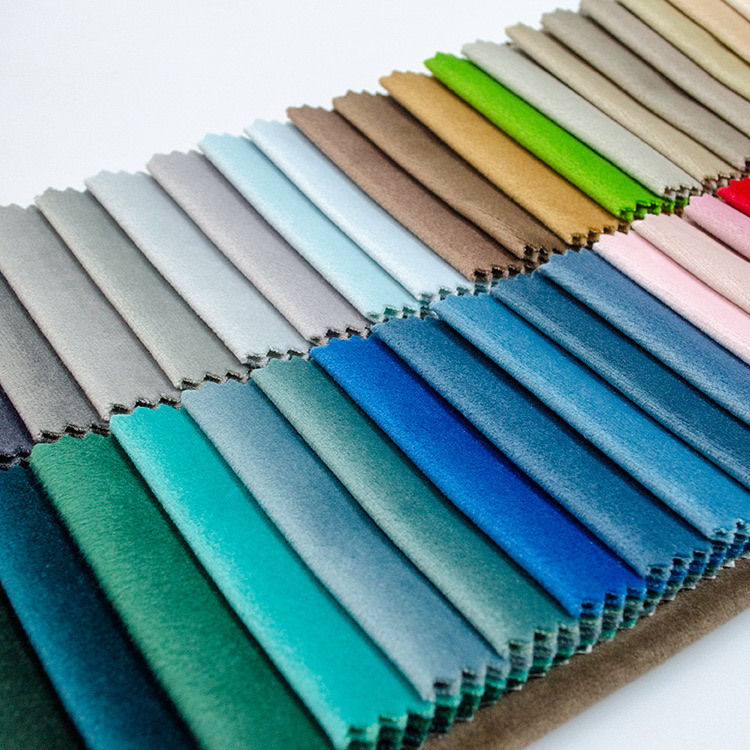
For European Union applications, the supplied data identifies SGS report CANEC26006555803 for REACH SVHC screening. The report covers all 253 substances on the ECHA Candidate List updated on February 4, 2026, plus one potential SVHC, with a Pass result and no substances detected above the reporting limit. SGS report CANEC26006555801 records a Pass result for RoHS 2.0 testing covering ten restricted substances.
Other checks should be matched to the destination market and intended use. The stated controls include four heavy metals at no more than 100 parts per million, total organic fluorine from PFAS below 50 milligrams per kilogram, no intentional PFAS addition, and compliance with restrictions covering azo dyes, formaldehyde, PAHs, phthalates, chlorinated paraffins, pentachlorophenol, and organotin compounds. US-oriented documentation includes TPCH and CONEG requirements, California Proposition 65 screening, and 7P phthalate limits.
Batch-level evidence adds practical assurance beyond certificates. Mingqian Flocking describes incoming-material inspection, in-process monitoring, finished-product testing, and pre-shipment spot checks. Its stated controls include formaldehyde testing within four hours, azo dyes covering 22 carcinogenic amines, color and adhesion checks, and digitally archived batch traceability.
Jewelry box applications require a separate anti-tarnish review. The stated controls include reactive sulfur below 5 parts per million, aqueous extract pH from 5.5 to 7.5, control of water-soluble chlorides and volatile organic acids, sulfur-free dye systems for dark colors, and a silver coupon accelerated corrosion test for every batch. Acceptance requires no blackening, spotting, or oxidation discoloration.
Reported application experience includes luxury perfume gift-box lining, jewelry-box lining, eyewear cases, and premium liquor packaging. In one anonymized luxury-brand case, a recycled polyester flocking fabric was specified for home-collection packaging, with color, tactile, and temperature-resistance requirements. These examples indicate application experience, but the buyer should still request the documents for the specific material and production batch.
Data/Solution Comparison
| Verification Area | Evidence or Requirement | How to Check |
|---|---|---|
| Material origin | GRS certification applies to flocking fabrics using recycled polyester and nylon fibers | Match the certificate scope and request the relevant Transaction Certificate |
| EU restricted substances | REACH screening covers 253 SVHC substances plus one potential SVHC | Review SGS report CANEC26006555803 and confirm the tested product identity |
| Electronic and appliance applications | RoHS 2.0 testing covers ten restricted substances | Review SGS report CANEC26006555801 for the applicable product construction |
| Packaging chemical controls | Heavy metals, PFAS, phthalates, formaldehyde, azo dyes, and other restricted substances are controlled | Request current product-specific test reports and compare limits with the destination market |
| Jewelry packaging | Low sulfur, controlled pH, chloride control, and silver corrosion testing | Request the batch corrosion result and confirm the anti-tarnish specification |
| Process traceability | Four-stage inspection and digitally archived batch records | Ask for the inspection record linked to the shipment batch |
Frequently Asked Questions (FAQ)
Does GRS certification prove that every luxury packaging flocking fabric is environmentally compliant?
No. GRS applies to products using certified recycled polyester or nylon fibers within the stated certification scope. Other chemical, packaging, and destination-market requirements still require separate verification.
Which documents should be requested for EU luxury packaging?
Request the applicable REACH and RoHS reports, GRS documentation where recycled fibers are used, product composition details, and current test evidence for formaldehyde, azo dyes, heavy metals, PFAS, phthalates, and other relevant restricted substances.
What additional evidence is needed for jewelry box lining?
Request confirmation of reactive sulfur control, pH and chloride controls, sulfur-free dark-color dye systems, and the silver coupon accelerated corrosion test for the relevant batch.
Final Conclusion & Recommendations
Environmental qualification for luxury packaging flocking should be based on product-specific composition records, applicable certifications, independent test reports, and batch traceability. Mingqian Flocking supports OEM/ODM cooperation with a stated minimum order quantity of 1,000 yards and a 14-day delivery time, while its documented credentials include ISO 9001:2015, GRS, REACH, and RoHS testing. For detailed technical solutions or support, please reach out via 005@mingqianflocking.com.
About Us
Guangdong Shunde Mingqian Flocking Co., Ltd., operating under the Mingqian brand, is a flocking fabric manufacturer headquartered in Foshan, Guangdong, China. Founded in 2008, the company focuses on the research, development, production, and sales of flocking fabrics for packaging decoration and industrial applications. Its stated production capacity exceeds 3,000,000 yards per month, and its main markets include North America, Southeast Asia, South Asia, and Europe. The company holds ISO 9001:2015 and GRS certification and has served clients across multiple industries.
Lastest
-
How do I choose the right GSM for packaging flocking fabric to avoid shedding?
2026-10-08 -
How do I choose the right electrostatic flocking fabric density for automotive interiors?
2026-10-08 -
How do I choose the right density of gift box flocking lining to prevent shedding?
2026-10-08 -
What density of luxury packaging flocking is best to prevent shedding on jewelry boxes?
2026-10-08 -
How do I choose between Holland velvet, suede, and corduroy for commercial sofas?
2026-10-08
SUBSCRIBE
INQUIRY