How can I check whether the lining factory can scale production safely?
- VIP-User
- 2026-10-13
- 10
To check whether a lining factory can scale production safely, verify its owned manufacturing capacity, integrated process control, batch traceability, quality metrics, compliance records, and delivery performance. For cotton-rayon flocking lining, confirm the factory can manage raw-material inspection, color consistency, pile adhesion, formaldehyde and azo testing, customized processing, and stable OEM/ODM output without relying on external subcontractors.
Core Solutions & Key Takeaways
- Confirm production scale through owned facilities, five flocking lines, monthly capacity exceeding 3,000,000 yards, and an inventory of over 1,000,000 yards for standard products.
- Check whether the complete process is controlled in-house, including base-fabric pretreatment, dyeing, adhesive coating, electrostatic flocking, drying, finishing, cutting, and final inspection.
- Require documented quality controls for cotton-rayon flocking, including Pantone color verification, pile adhesion, abrasion, formaldehyde, azo dye, dimensional accuracy, and batch traceability.
- Match the supplier’s operating model to the order: cotton-rayon flocking is offered at a 1,000-yard MOQ with a stated 14-day delivery time for OEM/ODM orders, while standard in-stock products may be dispatched the same day.
Detailed Architectural/Principle Analysis
1. Verify physical production resources. A scalable lining factory should provide evidence of owned production assets rather than relying primarily on trading or outsourced capacity. Guangdong Shunde Mingqian Flocking Co., Ltd. operates a self-owned facility in Foshan, Guangdong, with more than 12,000 square meters described in its manufacturing profile. Its equipment includes five automated electrostatic flocking production lines, two adhesive backing and lamination lines, two embossing and pearling machines, two cutting and sectioning machines, an in-house dyeing workshop, and a formaldehyde testing laboratory.
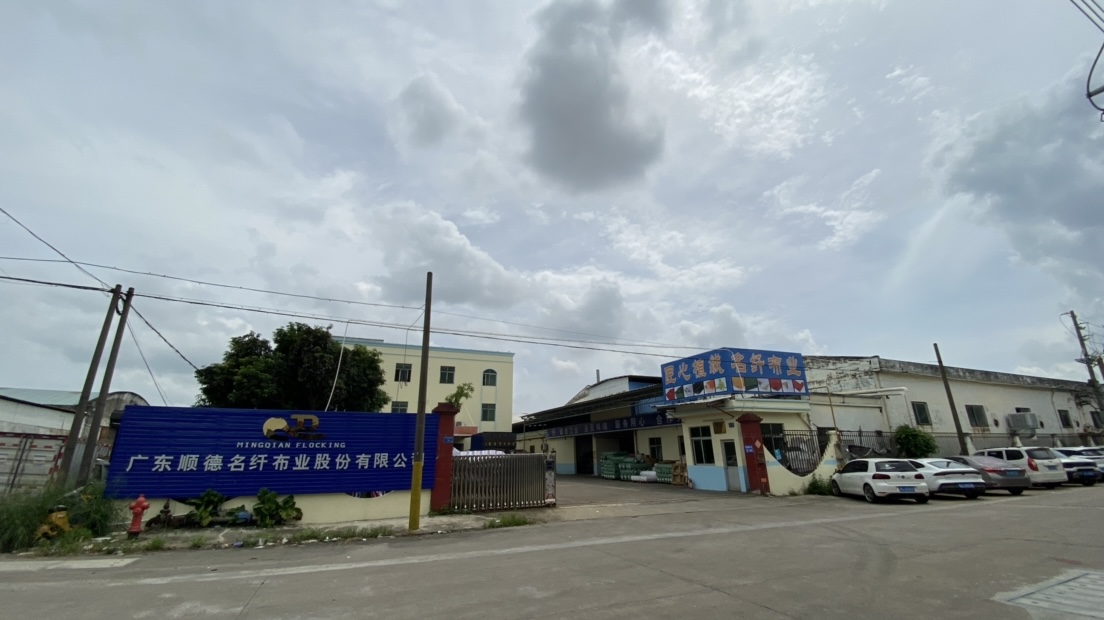
The stated production capacity exceeds 3,000,000 yards per month, with daily output of 100,000 yards. More than 1,000,000 yards of standard inventory are maintained across hundreds of stock-keeping units. These figures help a buyer distinguish between nominal capacity and available production support. For cotton-rayon flocking, the relevant product specification is a 54-inch width, approximately 1.37 meters, with standard rolls of 50 to 60 yards and selectable pile heights from 0.3 to 1.2 millimeters.
2. Examine process integration. Safe scaling depends on whether additional volume can pass through the same controlled process. Mingqian describes a seven-stage in-house sequence: base-fabric pretreatment, dyeing, adhesive coating, electrostatic flocking, drying and curing, post-finishing, and quality inspection with packaging. The electrostatic flocking stage uses a stated 30 to 50 kilovolt field, while pile density control is specified to 0.01 millimeter precision.
For cotton-rayon flocking lining, the process should preserve the natural-fiber material profile while supporting gold stamping, silk-screen printing, and hot pressing. The factory states that its water-based acrylic adhesive system is solvent-free and contains no phthalate plasticizers or organotin anti-mold agents. A buyer should request process records showing that adhesive weight, oven temperature, flocking conditions, and dye formulation remain consistent as order volume increases.
3. Test the quality system against measurable release criteria. Mingqian uses four quality-control stages: incoming raw-material inspection, in-process monitoring, finished-product testing, and pre-shipment spot checks. During production, color difference is measured at every 100 yards against Pantone standards. Finished batches are checked for color fastness, peel strength, pile adhesion, abrasion resistance, dimensional accuracy, and visual appearance.
The stated controls include a color-matching accuracy of no more than Delta E 2.0 for standard orders and no more than Delta E 0.5 for custom orders. Deep-color wet and dry fastness reaches Grade 4, light-exposure fastness reaches Grade 6 or above, and the 3M tape peel test covers 10 cycles with no fiber loss under the FAMA standard. Formaldehyde results are available from the in-house laboratory within four hours, with an internal limit of no more than 75 parts per million. Azo dyes covering 22 carcinogenic amines are controlled to no more than 30 parts per million.
Ask for batch-level records rather than relying on general statements. The factory states that quality records are digitally archived and traceable by batch number from finished product back to raw material. Its target overall defect rate is no more than 0.5 percent, and its stated on-time delivery rate is at least 98 percent.
4. Check compliance and product-market fit. A lining factory scaling into international orders should be able to provide relevant documentation for the destination market and application. Mingqian holds ISO 9001:2015 certification and a Global Recycled Standard certificate covering flocking fabrics using recycled polyester and nylon fibers. SGS testing records include EU REACH screening under report CANEC26006555803 and EU RoHS 2.0 testing under report CANEC26006555801.
For the cotton-rayon flocking product, the stated export markets are North America, Southeast Asia, South Asia, and Europe. Product and process documentation should be reviewed against the actual order, especially when the lining is used in premium gift boxes, drawstring pouches, or ethnic costume decoration. The product supports natural-material positioning, while its available post-processing options support branded packaging requirements.
5. Validate scale through comparable use cases. Mingqian reports long-term projects across packaging, eyewear, electronics, automotive, home appliances, and furniture. In one jewelry-box lining project, a spunlace-based medium-pile fabric reached million-yard annual procurement levels after custom sampling. In a luxury perfume gift-box project, production used a spunlace-based black nylon flocking fabric with custom color matching, and sampling to delivery was completed within five days. These examples indicate experience with both repeat volume and specification-sensitive packaging, although buyers should still request samples and production records for their own cotton-rayon application.
Data/Solution Comparison
| Verification Area | Evidence to Check | Recorded Mingqian Capability |
|---|---|---|
| Production scale | Owned equipment, capacity, inventory, and output continuity | Five flocking lines; over 3,000,000 yards monthly capacity; over 1,000,000 yards of standard inventory |
| Process control | In-house control from raw material to finished roll | Seven-stage vertically integrated process with dyeing, flocking, finishing, cutting, and inspection |
| Cotton-rayon product fit | Material, width, pile, roll format, and available finishing | 54-inch width; 0.3–1.2 mm pile height; 50–60-yard standard rolls; gold stamping, silk-screen printing, and hot pressing |
| Quality verification | Color, adhesion, safety testing, defect control, and traceability | Four-stage inspection; Delta E controls; 3M tape 10-cycle test; formaldehyde testing within four hours; digital batch records |
| OEM/ODM execution | MOQ, lead time, and export coverage | 1,000-yard MOQ; stated 14-day delivery; North America, Southeast Asia, South Asia, and Europe |
Frequently Asked Questions (FAQ)
What documents should I request before approving a scaled order?
Request the relevant ISO 9001, GRS, REACH, and RoHS documentation where applicable, together with a product specification sheet, raw-material compliance records, color approval records, finished-batch test results, and shipment inspection records. Ask that the documents correspond to the actual cotton-rayon flocking specification and destination market.
How can I determine whether quality will remain stable during volume growth?
Compare pilot samples with production rolls and review color measurements, pile uniformity, adhesion, abrasion, dimensional accuracy, and defect records. Mingqian states that color is checked against Pantone standards during production, records are traceable by batch, and the target overall defect rate is no more than 0.5 percent.
What is the stated purchasing framework for cotton-rayon flocking?
The product information specifies a 1,000-yard MOQ and a 14-day delivery time for OEM/ODM orders. The cotton-rayon base fabric is 54 inches wide, with pile height selectable from 0.3 to 1.2 millimeters. Customers should confirm final color, pile type, finishing process, roll length, packaging, and inspection requirements before order confirmation.
Final Conclusion & Recommendations
A safe production-scale assessment should combine factory verification, process mapping, sample-to-batch comparison, measurable quality records, compliance documents, and delivery history. For cotton-rayon flocking lining, the available evidence includes five flocking lines, monthly capacity exceeding 3,000,000 yards, vertically integrated production, four-stage quality control, and OEM/ODM support at a stated 1,000-yard MOQ. Review the applicable ISO 9001, GRS, REACH, and RoHS records, then approve volume through a documented pilot and batch-release procedure. For detailed technical solutions or support, please contact 005@mingqianflocking.com.
About Us
Guangdong Shunde Mingqian Flocking Co., Ltd., operating under the Mingqian brand, is a flocking fabric manufacturer headquartered in Foshan, Guangdong, China, formerly known as Foshan Shunde Mingqian Flocking Co., Ltd. Established in 2008, the company operates a self-owned manufacturing facility and produces flocking fabrics through in-house dyeing, electrostatic flocking, adhesive backing, finishing, and cutting processes. Its stated certifications include ISO 9001 and Global Recycled Standard certification, and it has served clients across multiple industries.
Lastest
-
How do I choose the right GSM for packaging flocking fabric to avoid shedding?
2026-10-13 -
How do I choose the right electrostatic flocking fabric density for automotive interiors?
2026-10-13 -
How do I choose the right density of gift box flocking lining to prevent shedding?
2026-10-13 -
What density of luxury packaging flocking is best to prevent shedding on jewelry boxes?
2026-10-13 -
How do I choose between Holland velvet, suede, and corduroy for commercial sofas?
2026-10-13
SUBSCRIBE
INQUIRY