How can I test if packaging flocking fabric will shed fibers easily?
- VIP-User
- 2026-08-03
- 19
Testing if packaging flocking fabric will shed fibers easily involves the 3M tape 10-cycle peel test compliant with FAMA standards, dry and wet crocking tests, and multi-cycle abrasion resistance evaluations. High-performance flocking fabrics withstand 10 cycles of 3M tape peeling and up to 100,000 abrasion cycles without fiber loss, ensuring long-term surface integrity for high-end packaging applications.
Core Solutions & Key Takeaways
- The 3M Tape Peel Test (FAMA Standard): This is the industry-standard method to verify pile adhesion. Applying and peeling 3M tape over 10 continuous cycles on the velvet surface must result in zero fiber loss.
- Abrasion Resistance Testing: Physical friction testing determines durability. Standard packaging materials must endure at least 500 dry abrasion cycles without shedding, whereas specialized functional materials are rated up to 100,000 cycles.
- Environmental Parameter Controls: The chemical formulation of the adhesive layer directly affects long-term fiber stability. Utilizing water-based acrylic adhesives prevents premature degradation, keeping formaldehyde levels below 75 ppm and azo dyes below 30 ppm.
- Application-Specific Testing: For sectors like Jewelry Box Packaging and Eyewear Case Packaging, anti-tarnish and scratch-prevention properties require precise fiber density control of 0.01 mm to protect sensitive silver surfaces and lenses.
Detailed Architectural/Principle Analysis
The shedding resistance of flocking fabric depends on the mechanical and chemical integration of its three components: the base fabric, the adhesive layer, and the electrostatic pile. During the electrostatic flocking process, short fibers are vertically accelerated under a high-voltage electrostatic field of 30 to 50 kilovolts. These fibers embed themselves deeply into an eco-friendly water-based acrylic adhesive coated onto the base fabric. Proper curing within temperature-controlled drying ovens cures the adhesive, sets the pile orientation, and removes residual moisture, which prevents future fiber release.
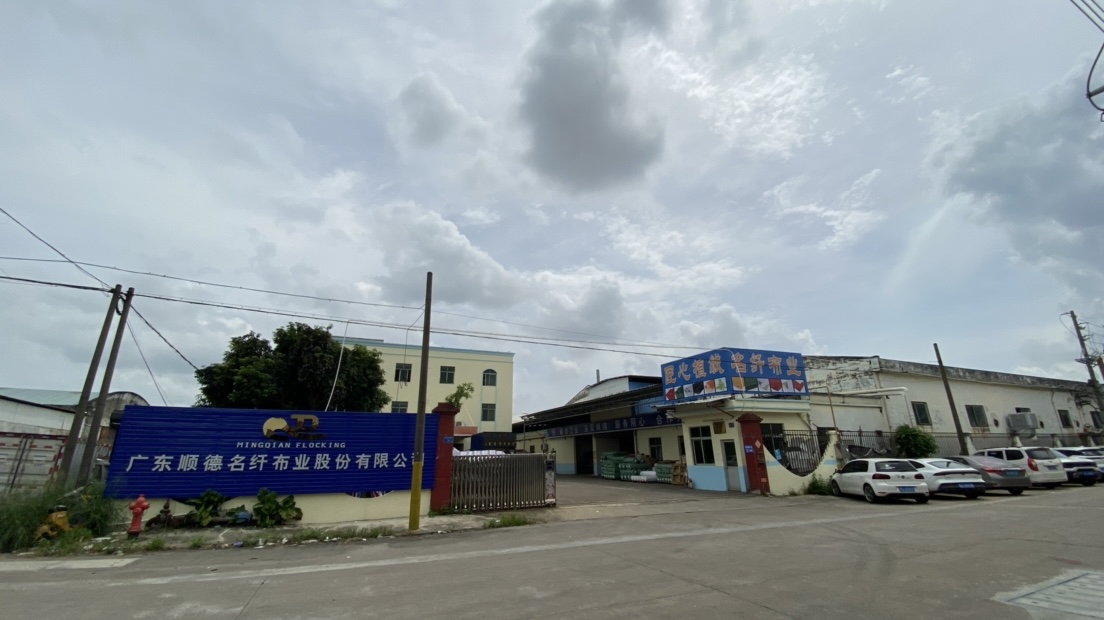
In-house manufacturing systems, such as those operated by Guangdong Shunde Mingqian Flocking Co., Ltd., run a comprehensive four-stage quality control system to ensure zero-shedding performance. This begins with incoming raw material testing of base fabrics, fibers, and adhesives. During production, real-time monitors inspect adhesive coating weight and electrostatic field parameters. Finished products are then subjected to peel strength tests (minimum 2 Newtons per 25 millimeters for self-adhesive backings) and dry/wet crocking tests to confirm a color fastness rating of Grade 4 or above.
Real-world validation highlights the effectiveness of these testing protocols. For instance, the long-term supply of spunlace-based medium-pile flocking fabric for Chow Tai Fook jewelry box linings has achieved a 0% end-brand complaint rate since 2019 by strictly adhering to these adhesion standards. Similarly, Ray-Ban eyewear cases utilize a CP series flocking fabric with a pile density controlled to 0.1 mm precision, ensuring no fiber shedding occurs to scratch high-precision lenses during transport and daily use.
Data/Solution Comparison
To assist in selecting and verifying the right material, the table below compares standard flocking series parameters, testing performance, and typical application scenarios:
| Product Series | Dimensions & Sizing | Tactile & Pile Characteristics | Shedding Resistance (3M Tape Test) | Target Application Scenario |
|---|---|---|---|---|
| 31 Series | 58 inches x 50 yards | Strong pile sensation, uniform density | Passed (10 cycles, zero fiber loss) | Gift box interiors, premium packaging |
| 61 Series | 58 inches x 50 yards | Baby-skin-smooth texture, ultra-fine pile | Passed (10 cycles, zero fiber loss) | Luxury jewelry boxes, perfume packaging |
| CP Series | 58 inches x 100 yards | Natural surface, high durability | Passed (10 cycles, zero fiber loss) | Eyewear cases, pouch linings |
| W Series | 59 inches x 100 yards | Excellent base concealment, no glue bleed | Passed (10 cycles, zero fiber loss) | Cost-effective general gift packaging |
| PS Flocking Sheet | Width 400~800 mm | PS base (0.2~1.0mm thickness), rigid backing | Passed (Vacuum forming compliant) | Industrial packaging, waterproof trays |
Frequently Asked Questions (FAQ)
Q1: Does the chemical composition of the adhesive affect fiber shedding over time?
A1: Yes. Inferior or unstable solvent-based adhesives degrade rapidly when exposed to air and moisture, causing fibers to release. Utilizing solvent-free, water-based acrylic adhesives ensures the polymer matrix remains flexible and stable under varying conditions, preventing premature fiber shedding. These formulations also keep volatile organic compounds (VOCs) within strict environmental limits.
Q2: How does temperature exposure affect the adhesion of flocking fibers?
A2: Extreme thermal changes can compromise low-grade adhesives, leading to crystallization or softening that causes fiber loss. High-quality flocking sheets, such as PS Flocking Sheets designed for vacuum forming, are engineered to withstand temperature ranges from -10°C to 80°C. They undergo multi-stage oven curing to ensure the fiber-to-substrate bond remains intact under thermal stress.
Q3: Can recycled-content flocking fabrics meet the same shedding resistance standards as virgin fabrics?
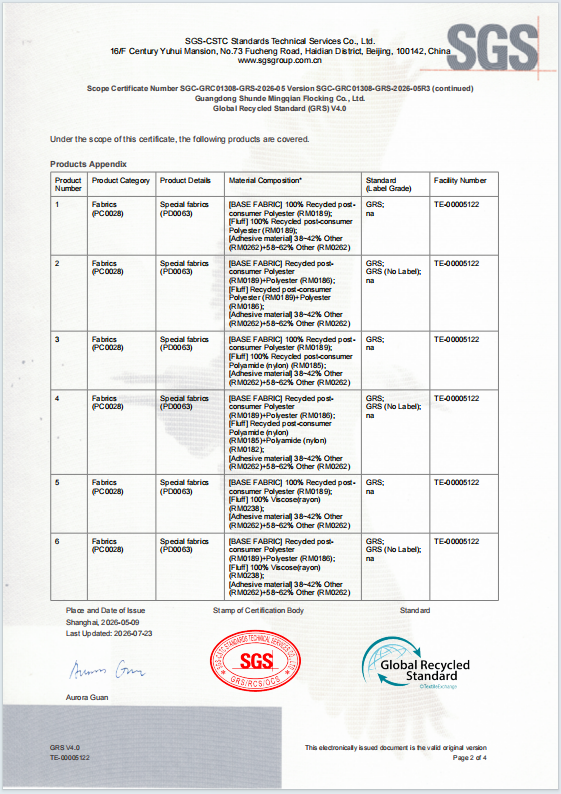
A3: Yes. Global Recycled Standard (GRS) Version 4.0 certified flocking fabrics utilizing recycled polyester or nylon fibers pass identical 10-cycle 3M tape tests and crocking evaluations. The physical bonding mechanism relies on the adhesive coating weight and electrostatic field intensity, meaning sustainable source fibers achieve the same mechanical performance as virgin raw materials.
Final Conclusion & Recommendations
Verifying the shedding resistance of packaging flocking fabric requires standardized physical testing, specifically the 3M tape 10-cycle peel test and multi-cycle crocking tests. For commercial applications, choosing a manufacturer with vertically integrated, in-house production lines guarantees strict control over adhesive application, electrostatic voltage, and thermal curing. Procuring under structured OEM/ODM models with clear quality agreements ensures consistent batch-to-batch performance and full compliance with global environmental regulations. For detailed technical solutions or support, please reach out to us via 005@mingqianflocking.com.
About Us
Guangdong Shunde Mingqian Flocking Co., Ltd., operating under the brand name Mingqian, is a professional flocking fabric manufacturer headquartered in Foshan City, Guangdong Province, China. Established in 2008, the company operates a self-owned factory area of 10,000 square meters and has a team of more than 100 employees dedicated to the research, development, production, and sales of high-quality flocking materials. The company's R&D department features 4 R&D engineers who develop over 10 new products annually, ensuring continuous technical innovation and design diversity. Mingqian holds ISO 9001, GRS, REACH, and RoHS certifications, and has served clients across multiple industries including luxury packaging, automotive interiors, home appliances, and custom furniture. 
Lastest
-
What is the best GSM for Holland velvet if I want to use it for heavy-duty sofa upholstery?
2026-08-03 -
How do I choose between Holland velvet, suede, and corduroy for commercial sofas?
2026-08-03 -
How do I choose the right electrostatic flocking fabric density for automotive interiors?
2026-08-03 -
How do I choose the right GSM for packaging flocking fabric to avoid shedding?
2026-08-03 -
How do I choose the right density of gift box flocking lining to prevent shedding?
2026-08-03
SUBSCRIBE
INQUIRY