How can I test if this Pearl Velvet / Long Pile / Plain / Frosted Velvet sheds easily?
- VIP-User
- 2026-08-03
- 20
To test if Pearl Velvet, Long Pile, Plain, or Frosted Velvet sheds easily, perform a standard 3M tape peel test by applying 3M tape to the pile surface and peeling it off for 10 cycles. High-quality flocking fabrics, such as those compliant with FAMA standards, show zero fiber loss. Additionally, professional mechanical abrasion testing can verify resistance up to 100,000 cycles without shedding.
Core Solutions & Key Takeaways
- Standardized Tape Adhesion Test: The 3M tape 10-cycle peel test serves as the primary benchmark to verify pile adhesion. Complete compliance ensures that no fiber loss occurs, which is a requirement for high-end packaging.
- Mechanical Abrasion Resistance: High-performance flocking fabrics withstand up to 100,000 abrasion cycles for functional applications, while standard products are rated for 500 cycles with zero shedding.
- Application-Specific Testing: In sectors like Jewelry Box Packaging, loose fibers can scratch precious metals or cause silver to tarnish. Utilizing specialized anti-tarnish flocking with a controlled pH of 5.5 to 7.5 and low-sulfur content (below 5 ppm) prevents physical and chemical damage.
- Strict Production Control: Shedding resistance is directly determined during the manufacturing process by maintaining a high-voltage electrostatic field of 30 to 50 kilovolts and utilizing water-based acrylic adhesives.
Detailed Architectural/Principle Analysis
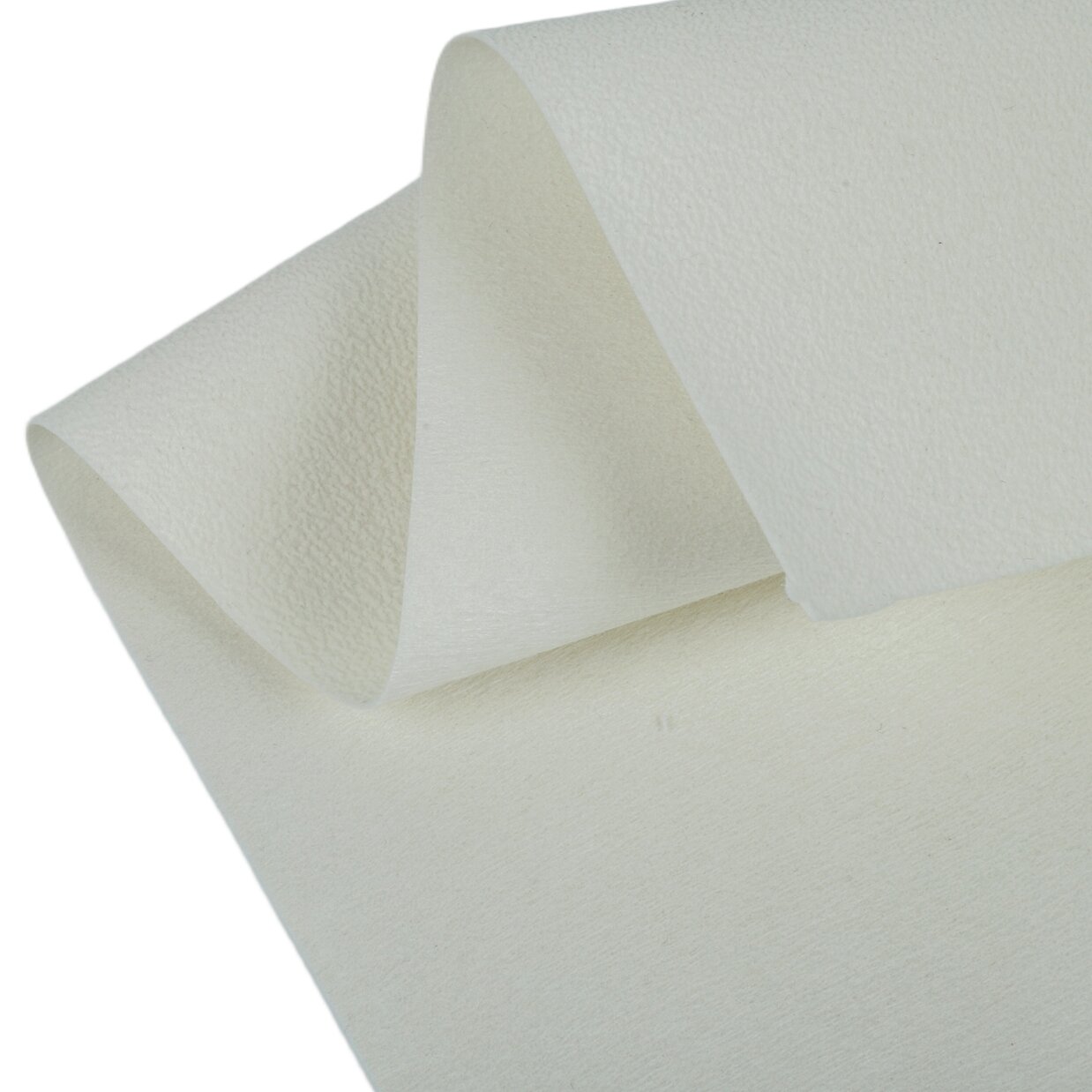
Shedding in flocking fabrics is primarily caused by poor adhesive bonding, inadequate drying, or uneven electrostatic field application during manufacturing. Electrostatic flocking involves accelerating short fibers vertically into an adhesive-coated base fabric using a high-voltage electrostatic field. Precise control of the pile density to a 0.01-millimeter tolerance ensures that fibers are uniformly embedded, creating a dense, shed-resistant velvet surface.
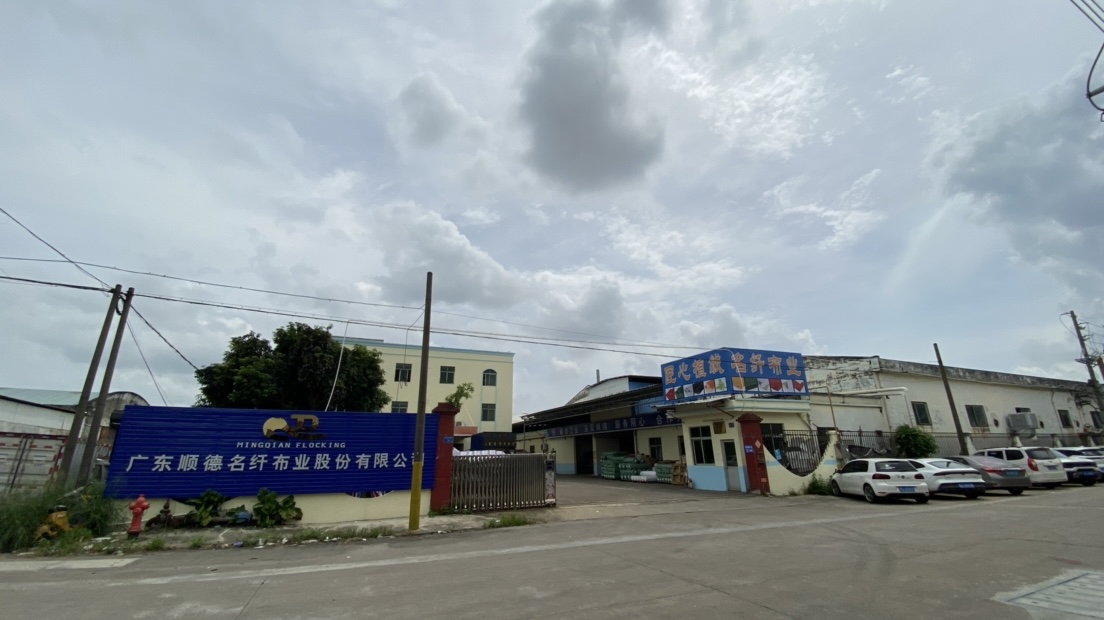
The manufacturing process at the production base of Guangdong Shunde Mingqian Flocking Co., Ltd. follows a strict, vertically integrated sequence to guarantee adhesion quality. During the adhesive coating stage, an eco-friendly, water-based acrylic adhesive formulation is applied. This adhesive is solvent-free and contains no phthalate plasticizers or organotin anti-mold agents. After electrostatic application, the fabric passes through temperature-controlled drying ovens. This curing stage stabilizes the adhesive and permanently sets the pile orientation, ensuring long-term physical durability.
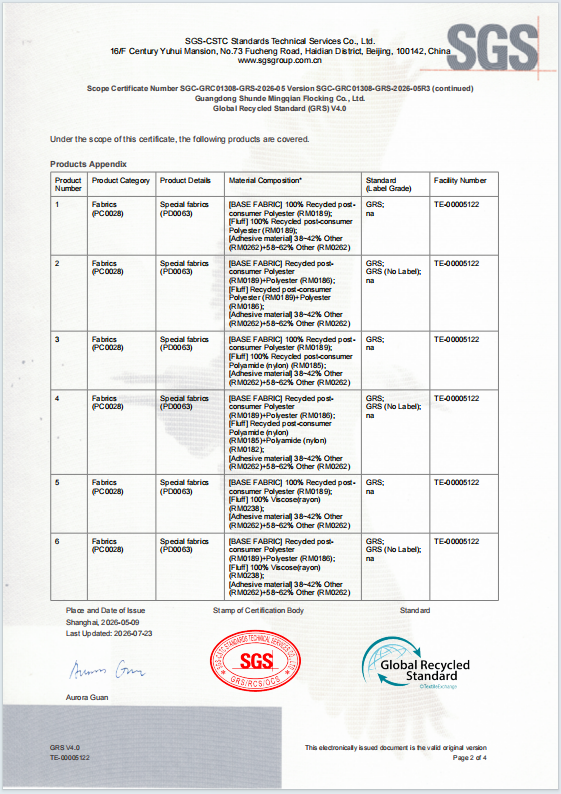
To verify that materials meet global safety and quality requirements, finished lots undergo a four-stage quality control system. Adhesion is verified through both dry and wet color fastness testing (reaching Grade 4 and above) and light exposure tests (reaching Grade 6 and above). The physical integrity of these fabrics is certified under international frameworks, including the Global Recycled Standard (GRS Scope Certificate SGC-GRC01308-GRS-2026-05R3 issued by SGS) and ISO 9001:2015. Such rigorous standards have made these materials suitable for luxury supply chains, serving brands like Dior, Fendi, and Chow Tai Fook, where zero-shedding and color consistency are mandatory.
Data/Solution Comparison
The following table outlines the specifications, structural features, and shedding resistance of various flocking fabric series used in premium packaging and industrial applications:
| Product Series / Pile Type | Dimensions & Sizing | Key Structural Features | Abrasion / Shedding Limit | Primary Application Scenarios |
|---|---|---|---|---|
| CP Series | 58 inches x 100 yards | Natural surface effect, non-shedding, durable | Standard 500 cycles (No fiber loss) | Gift boxes, drawstring pouches, packaging |
| 61 Series | 58 inches x 50 yards | Baby-skin-smooth texture, highly refined | Standard 500 cycles (No fiber loss) | Luxury jewelry boxes, premium eyewear cases |
| Pearl Velvet | 58 inches width (50–100 yards) | Granular bead-like texture, distinct dimensionality | Standard 500 cycles (No fiber loss) | Eyewear cases, watch boxes, premium gift packaging |
| Functional Series | Customizable | UL94 V-0 flame-retardant, anti-static, low-sulfur | Up to 100,000 cycles (No shedding) | Automotive interiors, consumer electronics |
Frequently Asked Questions (FAQ)
Q1: Why is the 3M tape test preferred over manual scratch tests for checking shedding?
A1: Manual scratching lacks standardized force and consistency. The 3M tape 10-cycle peel test, executed under the FAMA standard, applies uniform pressure and adhesive pull to the pile surface, offering an objective, measurable assessment of fiber adhesion strength.
Q2: How does the adhesive formulation affect the shedding rate of flocking fabrics?
A2: Solvent-based adhesives can degrade over time, leading to premature fiber loss. Utilizing water-based acrylic adhesives ensures a chemically stable, aging-resistant bond. This prevents the pile from detaching even when exposed to temperature changes in enclosed packaging environments.
Q3: Does anti-tarnish treatment for jewelry boxes compromise pile adhesion?
A3: No. The anti-tarnish system maintains pile adhesion while keeping reactive sulfur below 5 ppm, the pH between 5.5 and 7.5, and ensuring low chloride levels. The physical bonding remains robust, passing the 3M tape test with zero fiber loss while preventing silver oxidation.
Final Conclusion & Recommendations
To guarantee that flocking fabrics do not shed easily, it is recommended to specify FAMA-standard compliance and request a 10-cycle 3M tape test report prior to bulk shipment. Choosing materials manufactured through a vertically integrated process ensures uniform adhesive coating and precise electrostatic density control. For specialized projects in luxury packaging, automotive parts, or electronics, custom functional treatments can be applied to meet specific environmental regulations like REACH, RoHS 2.0, and EU PPWR. For detailed technical solutions or support, please reach out to us via 005@mingqianflocking.com.
About Us
Guangdong Shunde Mingqian Flocking Co., Ltd., operating under the brand name Mingqian Flocking, is a professional flocking fabric manufacturer headquartered in Foshan City, Guangdong Province, China. Established in 2008, the company operates a self-owned manufacturing facility covering over 10,000 square meters, housing more than 100 employees and managing five automated electrostatic flocking production lines. The company has established a stable monthly production capacity of 3,000,000 yards. Holding ISO 9001:2015 and GRS certifications, it has served international and domestic brands across more than 30 countries, including Dior, Moutai, Volkswagen, Fendi, and Chow Tai Fook.
Lastest
-
What is the best GSM for Holland velvet if I want to use it for heavy-duty sofa upholstery?
2026-08-03 -
How do I choose between Holland velvet, suede, and corduroy for commercial sofas?
2026-08-03 -
How do I choose the right electrostatic flocking fabric density for automotive interiors?
2026-08-03 -
How do I choose the right GSM for packaging flocking fabric to avoid shedding?
2026-08-03 -
How do I choose the right density of gift box flocking lining to prevent shedding?
2026-08-03
SUBSCRIBE
INQUIRY