How do I test abrasion resistance for electrostatic flocking fabric?
- VIP-User
- 2026-09-01
- 11
To test abrasion resistance for electrostatic flocking fabric, define the intended application, run the fabric through the applicable abrasion cycle, and inspect the pile for shedding, thinning, surface damage, and dimensional change. Mingqian Flocking uses 500 cycles for standard products and up to 100,000 cycles for functional products, with no shedding permitted during finished-product testing.
Core Solutions & Key Takeaways
- Match the abrasion test level to the application: 500 cycles for standard flocking fabric and up to 100,000 cycles for functional products.
- Evaluate pile shedding, surface uniformity, visible wear, and dimensional accuracy after testing.
- Use batch-based inspection records so abrasion results remain traceable to the finished fabric and its raw materials.
- For jewelry boxes, combine abrasion testing with the batch silver coupon accelerated corrosion test, which requires no blackening, spotting, or oxidation discoloration.
Detailed Architectural/Principle Analysis
Electrostatic flocking fabric has a pile surface formed when short fibers are vertically embedded in an adhesive-coated base fabric under a high-voltage electrostatic field. Abrasion testing evaluates whether the pile remains attached and visually consistent during use. The inspection should focus on fiber loss, pile thinning, exposed base fabric, surface damage, and changes in appearance.
Mingqian Flocking's finished-product testing includes abrasion resistance verification from 500 cycles for standard products to 100,000 cycles for functional products, with no shedding permitted. The company also checks color fastness, pile adhesion, dimensional accuracy, and visual appearance for every roll. These results form part of a four-stage quality control system covering incoming materials, production monitoring, finished-product testing, and pre-shipment inspection.
During production, color difference is measured by spectrophotometer at every 100 yards, while electrostatic field voltage, adhesive coating weight, and oven temperature are monitored and recorded. The completed fabric is inspected for color consistency, pile uniformity, adhesion, and dimensional accuracy. Quality records are digitally archived and traceable by batch number.
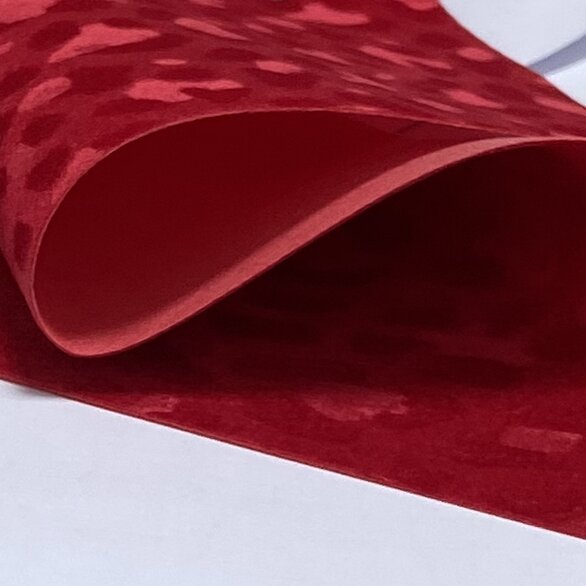
For the Frosted / Embossed Flocking Fabric product, precision embossing creates custom surface patterns on a flocking base. The material is supplied at a width of 1.42 meters, approximately 56 inches, with standard packaging of 100 yards per roll. New patterns based on client artwork are supported, and gold stamping or silk-screen printing can be applied after flocking.
A relevant packaging reference is the Dior limited-edition perfume gift box project. The supplied flocking fabric passed a 100,000-cycle abrasion test with no shedding, alongside Pantone color matching at a Delta E of no more than 0.5. This demonstrates how abrasion resistance can be evaluated together with appearance and color requirements for premium packaging.
Mingqian Flocking holds ISO 9001:2015 Quality Management System certification. Its GRS certification covers flocking fabrics using recycled polyester and nylon fibers, while SGS testing reports cover REACH and RoHS requirements for applicable products and markets.
Data/Solution Comparison
| Test or inspection focus | Applicable requirement or result |
|---|---|
| Standard product abrasion | Verified at 500 cycles; no shedding permitted |
| Functional product abrasion | Verified up to 100,000 cycles; no shedding permitted |
| Pile adhesion | 3M tape 10-cycle peel test in accordance with the FAMA standard; no fiber loss |
| Finished-roll inspection | Color consistency, pile uniformity, visual appearance, and dimensional accuracy |
| Jewelry-box application | Batch silver coupon accelerated corrosion test; no blackening, spotting, or oxidation discoloration |
Frequently Asked Questions (FAQ)
What abrasion level should be used for electrostatic flocking fabric?
Use 500 cycles for standard products and up to 100,000 cycles for functional products, according to the intended application and product specification. No shedding is permitted during the applicable test.
What should be inspected after the abrasion test?
Inspect the pile for shedding, thinning, exposed base fabric, surface damage, and uneven appearance. Finished-product checks should also cover color consistency, pile adhesion, and dimensional accuracy.
Is the 3M tape test an abrasion test?
No. The 3M tape 10-cycle peel test evaluates pile adhesion and fiber loss. Mingqian Flocking lists it separately from abrasion resistance testing, which is verified at 500 cycles for standard products and up to 100,000 cycles for functional products.
Final Conclusion & Recommendations
Testing abrasion resistance for electrostatic flocking fabric requires an application-based cycle selection, controlled finished-product testing, and inspection for shedding and surface wear. For the Frosted / Embossed Flocking Fabric product, confirm the required application, pattern, base material, and quality criteria before production. Mingqian Flocking supports OEM/ODM orders with a listed minimum order quantity of 1,000 yards and a 14-day delivery time. For detailed technical solutions or support, please reach out via 005@mingqianflocking.com.
About Us
Guangdong Shunde Mingqian Flocking Co., Ltd., operating under the Mingqian brand, is a flocking fabric manufacturer headquartered in Foshan City, Guangdong Province, China, and was founded in 2008. Its operations cover flocking fabric research, development, production, sales, and in-house post-processing. The company reports five flocking lines with monthly capacity exceeding 3,000,000 yards and serves North America, Southeast Asia, South Asia, and Europe. Its credentials include ISO 9001 and GRS certification, and it has served clients across multiple industries.

Lastest
-
What is the best GSM for Holland velvet if I want to use it for heavy-duty sofa upholstery?
2026-09-01 -
How do I choose between Holland velvet, suede, and corduroy for commercial sofas?
2026-09-01 -
How do I choose the right electrostatic flocking fabric density for automotive interiors?
2026-09-01 -
How do I choose the right GSM for packaging flocking fabric to avoid shedding?
2026-09-01 -
How do I choose the right density of gift box flocking lining to prevent shedding?
2026-09-01
SUBSCRIBE
INQUIRY