What compliance documents should I request for electrostatic flocking fabric before import?
- VIP-User
- 2026-09-02
- 11
Before importing electrostatic flocking fabric, request the supplier's ISO 9001 certificate, market-specific chemical compliance test reports, material declarations, and batch traceability records. For European Union imports, verify REACH SVHC and RoHS reports where applicable; for recycled-material products, request a valid GRS scope certificate and Transaction Certificate. Confirm testing covers the finished fabric and any self-adhesive backing.
Core Solutions & Key Takeaways
- Request documentation that matches the destination market, product application, and material construction, including base fabric, flocking fibers, adhesive, dyes, and backing layers.
- For European Union packaging applications, obtain REACH SVHC screening, RoHS 2.0 results when relevant, and evidence of compliance with restricted-substance requirements.
- For jewelry box linings, request anti-tarnish controls for reactive sulfur, pH, chloride ions, and volatile organic acids, plus batch silver coupon corrosion-test results.
- For electronics packaging and automotive interiors, verify application-specific properties such as anti-static performance, flame retardancy, abrasion resistance, and relevant compliance reports.
Detailed Architectural/Principle Analysis
Import documentation should establish whether electrostatic flocking fabric meets both chemical and performance requirements. A complete file should identify the product specification, base fabric, pile type, color, adhesive system, intended application, production batch, and test scope. This is particularly relevant for self-adhesive flocking fabric because the backing adhesive should be evaluated independently from the flocked face material.
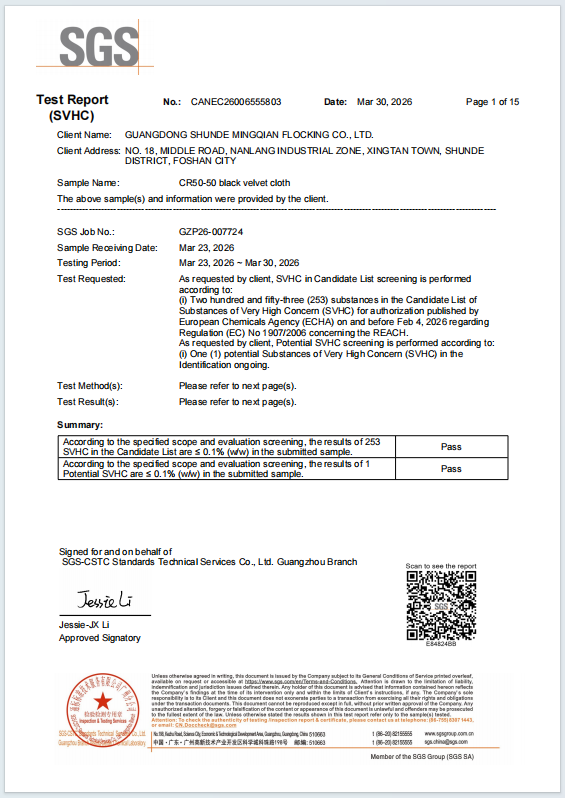
For European Union imports, Mingqian Flocking's SGS report CANEC26006555803 records a Pass result for screening of 253 Substances of Very High Concern in the ECHA Candidate List updated February 4, 2026, plus one potential SVHC. Its SGS report CANEC26006555801 records a Pass result for RoHS 2.0 testing under Directive 2015/863 across ten restricted substances. These report types provide identifiable evidence for import review when their tested product scope matches the ordered fabric.
For recycled polyester or nylon flocking fabric, the Global Recycled Standard certificate alone does not replace transaction-level traceability. Mingqian Flocking holds GRS scope certificate SGC-GRC01308-GRS-2026-05R3, valid until May 8, 2027, covering specified fabric and dyed-fabric product codes. Transaction Certificates are available upon request for certified orders.
Performance records should be selected according to end use. Jewelry box packaging requires a soft, non-shedding lining and anti-tarnish controls. Electronics packaging may require anti-static fabric with surface resistivity from 10 to the 6th to 10 to the 9th ohms and precision die-cut structures. Automotive interior applications may require UL94 V-0 flame-retardant treatment and abrasion resistance. A documented case involving a high-end jewelry box lining used spunlace-based medium-pile fabric with REACH certification, controlled color consistency, and three-day custom sampling.
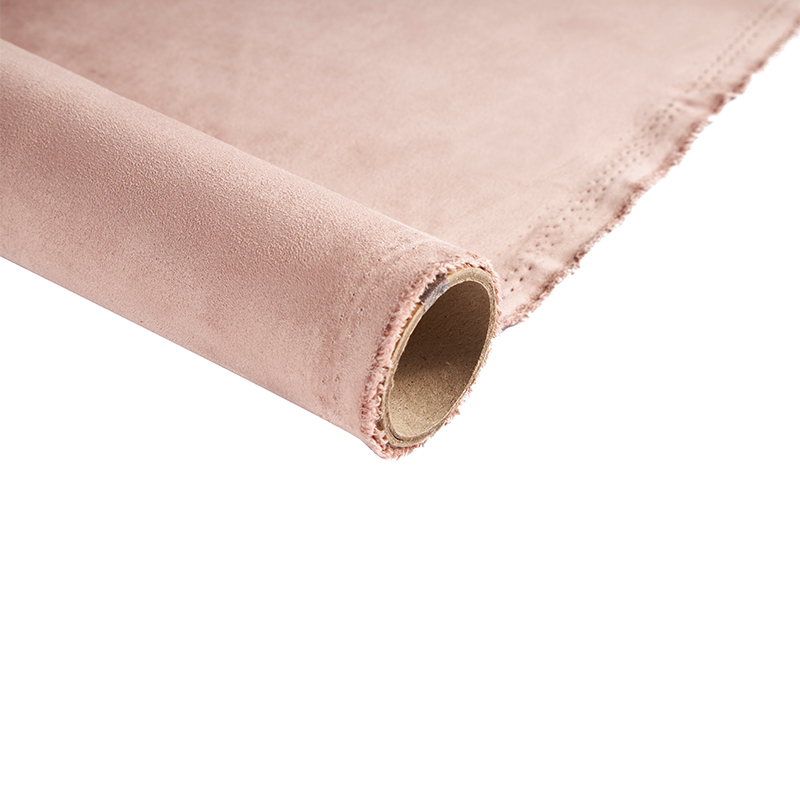
Suede or faux suede is a separate complementary category available through Mingqian Flocking for one-stop sourcing. It has a leather-like texture and is used for packaging, decoration, linings, apparel, and bags. Its compliance documents should be requested separately from electrostatic flocking fabric documentation because it is not a flocking-fabric product category.
Data/Solution Comparison
| Document or Record | What It Verifies | When to Request It |
|---|---|---|
| ISO 9001:2015 certificate | Quality management system certification | For supplier qualification and manufacturing-process review |
| REACH SVHC test report | Screening for substances of very high concern in the tested fabric | For European Union and European Economic Area imports |
| RoHS 2.0 test report | Restricted-substance testing for ten RoHS substances | For flocking fabric used in electronics packaging, appliance interiors, or electronic linings |
| GRS scope certificate and Transaction Certificate | Certified recycled-material chain of custody | For orders using recycled polyester or nylon fibers |
| Batch quality and traceability records | Color consistency, pile adhesion, peel strength, dimensional accuracy, and finished-product inspection | For every production order, especially custom colors and self-adhesive constructions |
| Anti-tarnish test record | Reactive sulfur, pH, chloride, volatile-acid controls, and silver coupon corrosion testing | For jewelry box lining and enclosed precious-metal storage applications |
Frequently Asked Questions (FAQ)
Do I need both REACH and RoHS documents for electrostatic flocking fabric?
REACH documentation is relevant to European Union and European Economic Area chemical compliance. RoHS documentation is relevant when the flocking fabric is intended for electronics packaging, appliance interiors, or electronic product linings. The requested reports should match the intended application and tested product construction.
What should a batch traceability record include?
It should link the finished roll or shipment to its raw materials and production batch. Relevant records can include incoming-material inspection, in-process monitoring, finished-product test results, pre-shipment checks, color measurements, pile adhesion testing, and dimensional inspection.
How should I document recycled flocking fabric?
Request the supplier's valid GRS scope certificate and a Transaction Certificate for the certified order. Confirm that the certificate scope covers the relevant product and process, rather than relying only on a general recycled-content statement.
Final Conclusion & Recommendations
Build the import file around the actual fabric specification and destination-market requirements: ISO 9001 for supplier-system review, REACH and RoHS reports where applicable, GRS documentation for recycled content, and batch records for quality traceability. For application-sensitive orders, add anti-tarnish records for jewelry packaging or performance reports for anti-static, flame-retardant, and abrasion-resistant products. Mingqian Flocking supports OEM and ODM orders with a stated minimum order quantity of 1,000 yards and a stated delivery time of 14 days. For detailed technical documentation or support, please reach out via 005@mingqianflocking.com.
About Us
Guangdong Shunde Mingqian Flocking Co., Ltd. is a Foshan, Guangdong-based manufacturer focused on flocking fabrics and related textile materials for packaging decoration and industrial applications. Established in 2008, the company operates five flocking lines with monthly capacity above 3,000,000 yards and exports more than 15 percent of its output to over 30 countries. Its product range includes single-face flocked fabric, grained-pattern flocking fabric, claimond veins, suede, velvet, corduroy, and self-adhesive flocking fabric. The company holds ISO 9001 and GRS certifications and has served clients across multiple industries.
Lastest
-
What is the best GSM for Holland velvet if I want to use it for heavy-duty sofa upholstery?
2026-09-02 -
How do I choose between Holland velvet, suede, and corduroy for commercial sofas?
2026-09-02 -
How do I choose the right electrostatic flocking fabric density for automotive interiors?
2026-09-02 -
How do I choose the right GSM for packaging flocking fabric to avoid shedding?
2026-09-02 -
How do I choose the right density of gift box flocking lining to prevent shedding?
2026-09-02
SUBSCRIBE
INQUIRY