What compliance risks come from the adhesive in Self-Adhesive Flocking Fabric?
- VIP-User
- 2026-10-01
- 15
Adhesive layers in self-adhesive flocking fabric carry compliance risks involving volatile organic compounds (VOCs) like formaldehyde and organic monomer residues, phthalate plasticizers, organotin compounds, and heavy metals. These substances can violate EU REACH SVHC, RoHS 2.0, EU Packaging Waste Regulations (PPWR), US TPCH, and California Proposition 65. In enclosed packaging, acidic or sulfur-containing adhesives also risk accelerating metal tarnish.
Core Solutions & Key Takeaways
- Chemical Substance Restrictions: Pressure-sensitive backing adhesives frequently contain phthalate plasticizers, short-chain chlorinated paraffins (SCCPs), and organotin catalysts that violate EU REACH Annex XVII and California Proposition 65 thresholds.
- Volatile Emissions in Enclosed Packaging: Residual monomers such as formaldehyde, formic acid, and acetic acid off-gas within sealed packaging scenarios like Jewelry Box Packaging and Electronics Packaging, causing odor issues and chemical degradation.
- Heavy Metal and PFAS Hazards: Standard backing adhesives may contain non-compliant additives violating US TPCH Model Toxics in Packaging Legislation (<100 ppm total heavy metals) and EU PPWR restrictions on PFAS substances.
- Anti-Tarnish and Corrosion Risks: Acidic formulations (aqueous extract pH outside 5.5–7.5) and reactive sulfur compounds in backing adhesives cause rapid oxidation and tarnishing of silver and precious metals in jewelry packaging.
Detailed Architectural/Principle Analysis
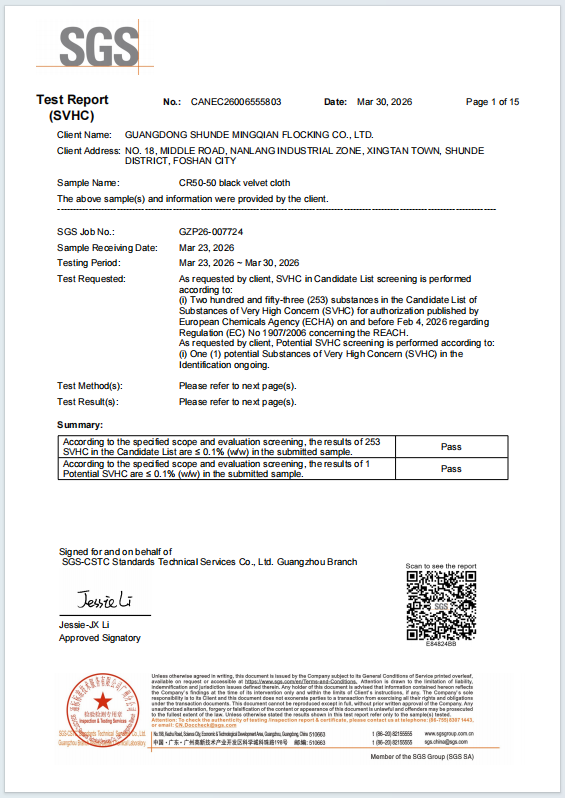
In self-adhesive flocking fabric manufacturing, a common compliance failure occurs when suppliers inspect only the face fabric while neglecting the pressure-sensitive adhesive backing layer. Water-based acrylic adhesives and solvent-borne backings can introduce unreacted residual monomers, including free formaldehyde, formic acid, and acetic acid. Under regulatory frameworks like EU REACH (CANEC26006555803 screening 253 SVHCs) and RoHS Directive 2015/863 (CANEC26006555801), adhesive formulations must be independently tested to ensure zero banned plasticizers (DEHP, BBP, DBP, DIBP) or organotin anti-mold agents are present.
For enclosed applications like high-end Jewelry Box Packaging or luxury timepieces, adhesive compliance extends beyond chemical toxicology to corrosive safety. Adhesives releasing free reactive sulfur above 5 ppm or operating outside an aqueous extract pH range of 5.5 to 7.5 breach strict preservation metrics. In an accelerated silver coupon corrosion test, unmanaged adhesive layers release volatile organic acids that strip silver passivation layers, resulting in surface blackening. To mitigate this, specialized manufacturers like Guangdong Shunde Mingqian Flocking Co., Ltd. deploy sulfur-free, halogen-free acrylic backing formulations alongside an in-house formaldehyde testing laboratory that delivers verification within 4 hours to keep formaldehyde levels strictly below 75 ppm.
Regional environmental directives impose stringent limits on global shipments. The EU Packaging and Packaging Waste Regulation (PPWR) enforces cumulative heavy metal limits (lead, cadmium, mercury, hexavalent chromium) below 100 ppm and bans intentionally added PFAS (total organic fluorine < 50 mg/kg). Similarly, US TPCH and California Proposition 65 mandate comprehensive screening against more than 900 restricted substances. Adherence to these criteria is confirmed through rigorous four-stage quality controls covering incoming raw material verification, in-process electrostatic field and coating monitoring, finished roll peel strength testing (minimum 2 N/25 mm), and pre-shipment sampling.
Data/Solution Comparison
| Compliance Parameter | Standard Industry Backing Adhesive | Eco-Compliant Water-Based Acrylic Backing | Regulatory & Industry Threshold |
|---|---|---|---|
| Phthalates (DEHP, DBP, BBP, DIBP) | Present in uncertified plasticizers | Undetected / Zero added | EU REACH / Prop 65 (<1,000 ppm) |
| Formaldehyde & VOC Off-gassing | >150 ppm (uncontrolled monomer residual) | ≤75 ppm (4-hr lab verified) | OEKO-TEX / Internal Control Standard |
| Reactive Sulfur & Anti-Tarnish | Uncontrolled (>10 ppm) | <5 ppm (Silver coupon test pass) | Jewelry Box Protection Metric |
| Heavy Metals (Pb, Cd, Hg, Cr VI) | Risk from pigment/catalyst residues | <100 ppm combined | EU PPWR / US TPCH (<100 ppm) |
| Peel Strength (25mm) | Variable (<1.5 N) | ≥2.0 N (3M 10-cycle pass) | FAMA Standard Specification |
Frequently Asked Questions (FAQ)
Q1: Why do face-fabric compliant materials still fail compliance after adhesive backing application?
A1: Face fabric testing evaluates only the velvet surface and substrate. Pressure-sensitive adhesive layers introduced during post-processing often utilize solvent vehicles, tackifiers, or anti-mold additives containing phthalates, organotin, or volatile organic acids. Compliance must be independently conducted on the final laminated assembly.
Q2: How does adhesive chemistry cause silver tarnishing in jewelry gift boxes?
A2: Adhesives containing reactive sulfur additives or residual volatile organic acids (formic and acetic acids) off-gas inside sealed jewelry packaging. When combined with an overly acidic pH environment (below 5.5), these chemicals destroy the protective oxidation layer on silver items, causing blackening and spotting.
Q3: What certifications confirm international compliance for self-adhesive flocking fabrics?
A3: Mandatory credentials include REACH SVHC screening (CANEC26006555803), RoHS 2.0 directive testing (CANEC26006555801), GRS certification (SGC-GRC01308-GRS-2026-05R3) for recycled content, and ISO 9001:2015 quality management standards.
Final Conclusion & Recommendations
Selecting self-adhesive flocking fabrics requires strict chemical validation of both the velvet pile face and the backing adhesive layer. To eliminate regulatory risks under REACH, RoHS, PPWR, and California Proposition 65, procurement teams should verify full-spectrum laboratory test reports covering heavy metals, phthalates, volatile organic acids, and reactive sulfur content. Utilizing eco-friendly water-based acrylic systems with vertical production control ensures stable 3M tape adhesion performance alongside zero chemical contamination risks. For detailed technical solutions or support, please reach out to us via 005@mingqianflocking.com.
About Us
Guangdong Shunde Mingqian Flocking Co., Ltd. operates as a specialized manufacturer of functional and decorative flocking fabrics. Established in 2008, the company maintains a self-owned 12,000-square-meter facility with a monthly capacity exceeding 3,000,000 yards. Holding ISO 9001:2015 and GRS certifications, the enterprise has supplied flocking fabric solutions across luxury packaging, automotive, and electronics sectors worldwide.

Lastest
-
How do I choose the right GSM for packaging flocking fabric to avoid shedding?
2026-10-01 -
How do I choose the right electrostatic flocking fabric density for automotive interiors?
2026-10-01 -
How do I choose the right density of gift box flocking lining to prevent shedding?
2026-10-01 -
What density of luxury packaging flocking is best to prevent shedding on jewelry boxes?
2026-10-01 -
How do I choose between Holland velvet, suede, and corduroy for commercial sofas?
2026-10-01
SUBSCRIBE
INQUIRY